
ヒトの進化と言語能力の発達 Human Evolution and the Development of Linguistic Capacity
-

- 日本語
- English
-
私達の祖先はどのような経緯を経て「しゃべるヒト」になったのでしょうか。コトバを操るには、表現し、理解するための身体能力および高度な認知や思考能力が必要です。発掘された道具の分析は、コトバを操る能力の発達経緯の推測につながります。
-
How did our ancestors become Homō loquēns, ‘talking human’? The ability to manipulate language requires advanced cognitive and thinking skills, as well as the physical ability to express and understand. Analysis of excavated tools can lead to speculation about the development of the ability to manipulate language.
発音器官の発達 Articulatory Organs
- 2-1c_1.webm
音声言語で使う器官:口腔形状の特徴
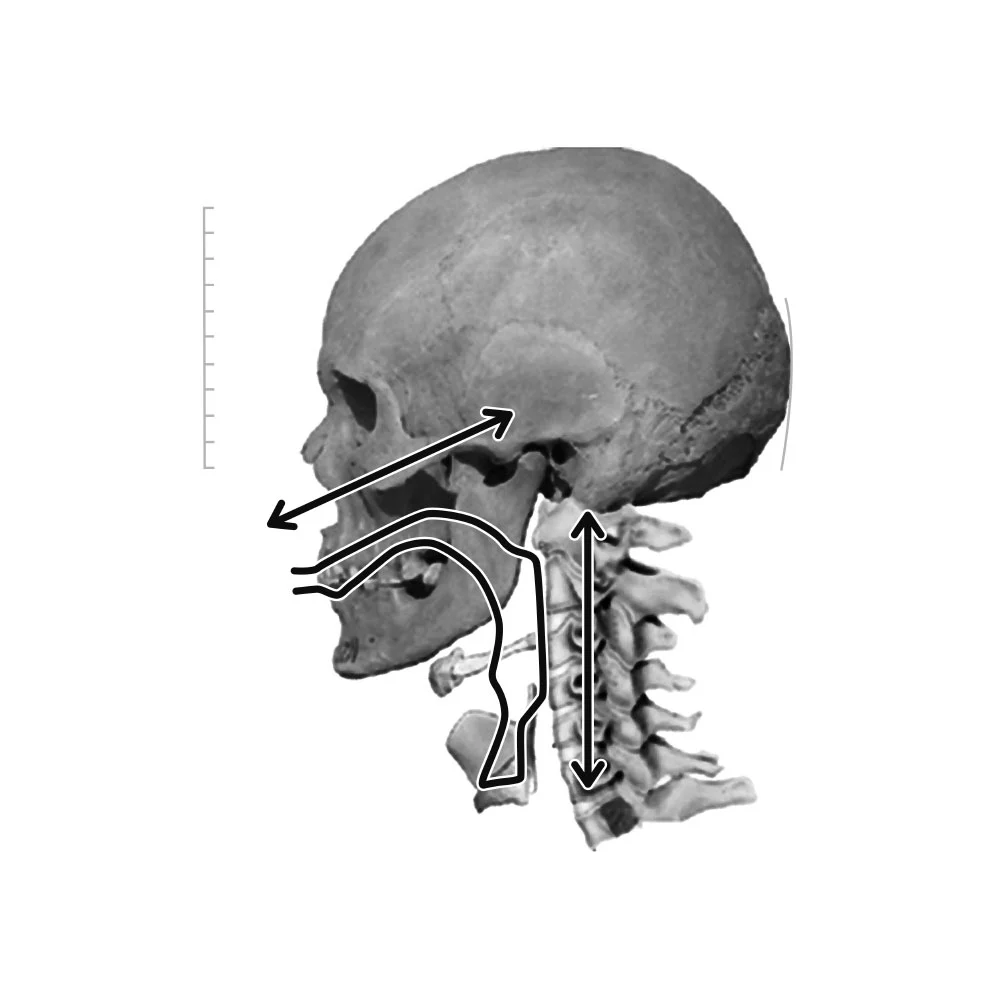
ヒトの舌はチンパンジーよりも短く丸く、「つ」の字のように折りたたまれています。縦が長くなり、喉周辺の容積が増えたため、舌を動かす範囲が広がり、様々な語音を調音することができるようになりました。
The Form of Oral Cavity: Articulating Spoken Language
Human’s tongues are shorter and rounder than that of a chimpanzee and are folded in the shape of the hiragana “tsu”. Since it became longer and the volume around the throat increased, the range of the movement for the tongue also increased, allowing for various tones in the speech.
上肢の発達 Development of upper limbs
- 37_1.webm
手話言語で使う器官:手の形の特徴
チンパンジーの掌は細長く、親指が短く、木登りや枝渡りなど、樹上での生活や移動に適した形になっています。ヒトは、二足歩行のおかげで、手を移動以外の活動に使用できます。指を繊細に動かすための筋肉が発達しており、手先での細かい作業が可能です。
The Form of Hands: Articulating Signed Language
Chimpanzees have elongated palms and relatively shorter thumbs as an adaptation for their arboreal lives, such as climbing trees and swinging between branches. Humans on the other hand can utilize hands for activities other than transportation thanks to bipedalism. Humans have opposable thumbs suited for fine movements of independent fingers.
道具からみた認知の発達 Cognitive Ability Inferred through Tools
- 38_1.webm
チンパンジーの道具
チンパンジーはヒト以外の生物の中で、最も多様な道具を使います。西アフリカのチンパンジーは、ふたつの石をそれぞれ台とハンマーにして、硬いナッツを割って食べることがあります。しかし、ヒトのように素材を意図的に加工して石器を作ることはありません。
協力:林美里(中部学院大学)
Chimpanzees’ tools
Among non-human organisms, chimpanzees use the most diverse tools. Chimpanzees of West Africa use two rocks as the stage and a hammer to crack hard nuts for meals. However, they do not purposely process materials into stone tools.
Contributed by Hayashi Misato (Chubu Gakuin University)
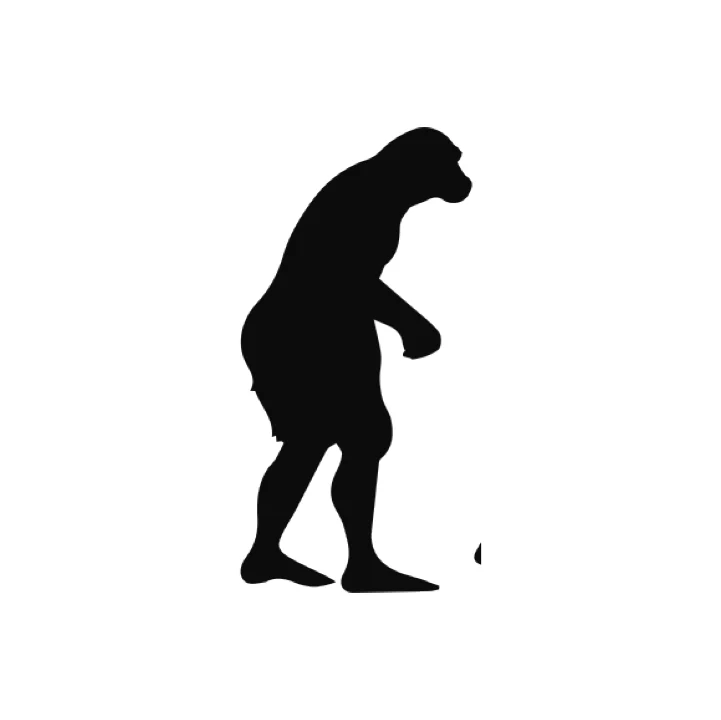
アウストラロピテクス属(猿人) Australopithecus
- 2-1b-1.webm
400-100万年前・アフリカ
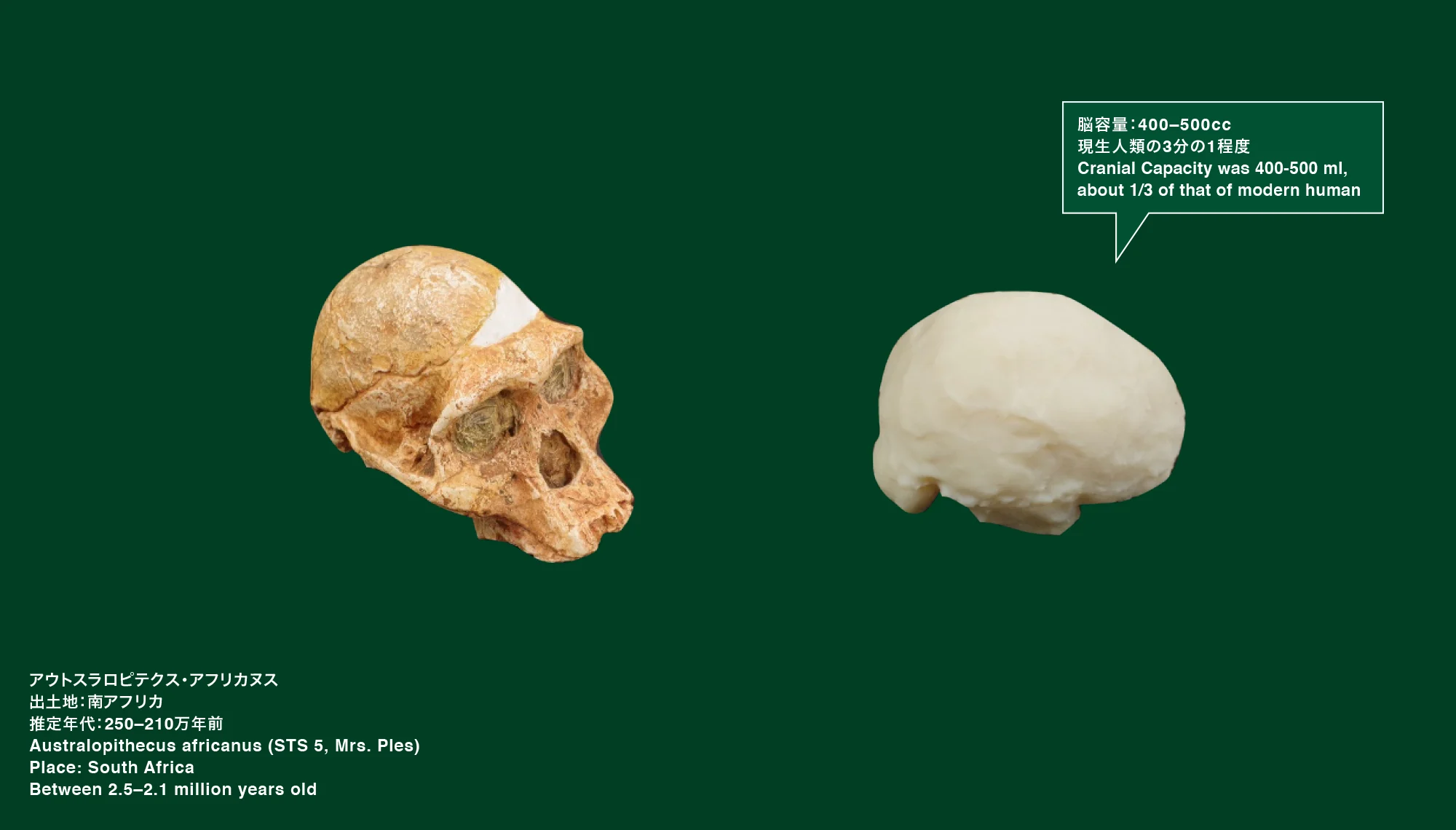
ヒトと類人猿、両方の特徴を備えていました。樹上生活をしていたと考えられていますが、直立二足歩行も可能でした。生後の成長が速かったため、学習や社会性の増進は不十分でした。4 to 1 million years ago; Africa
They had characteristics of both humans and apes. It is believed that they lived in the trees, but they could also walk upright. Since they matured quickly, learning and promotion of sociability were inadequate.
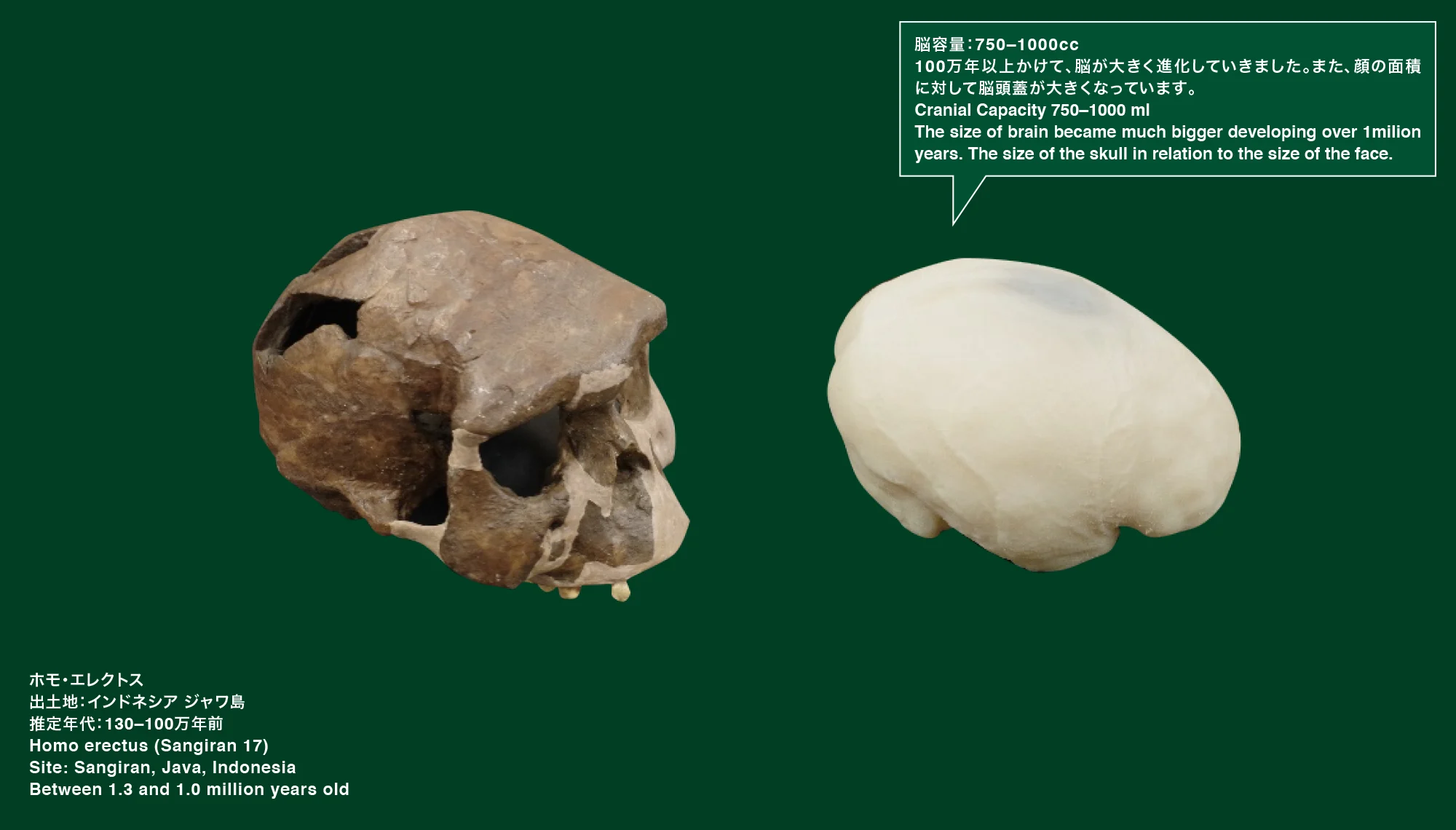
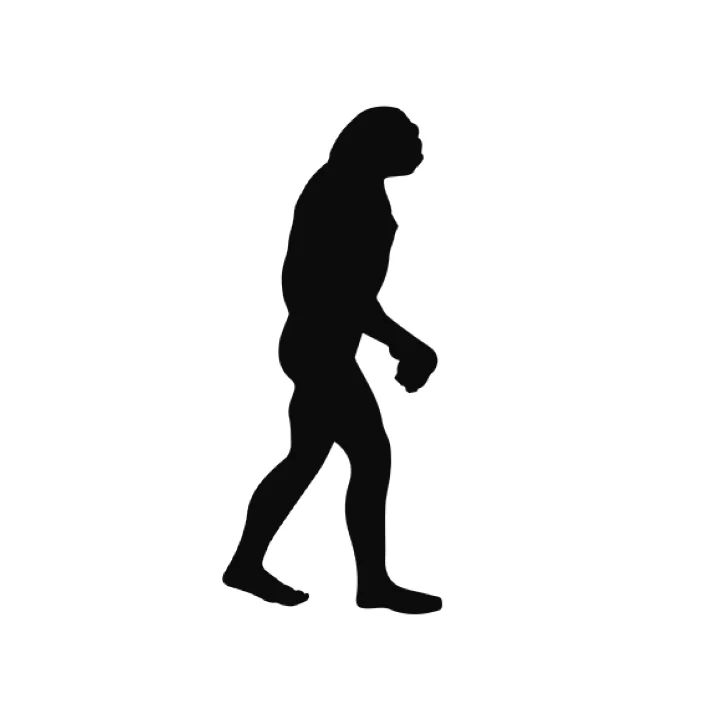
ホモ・エレクトス(原人) Homo erectus
- 2-1b-2.webm
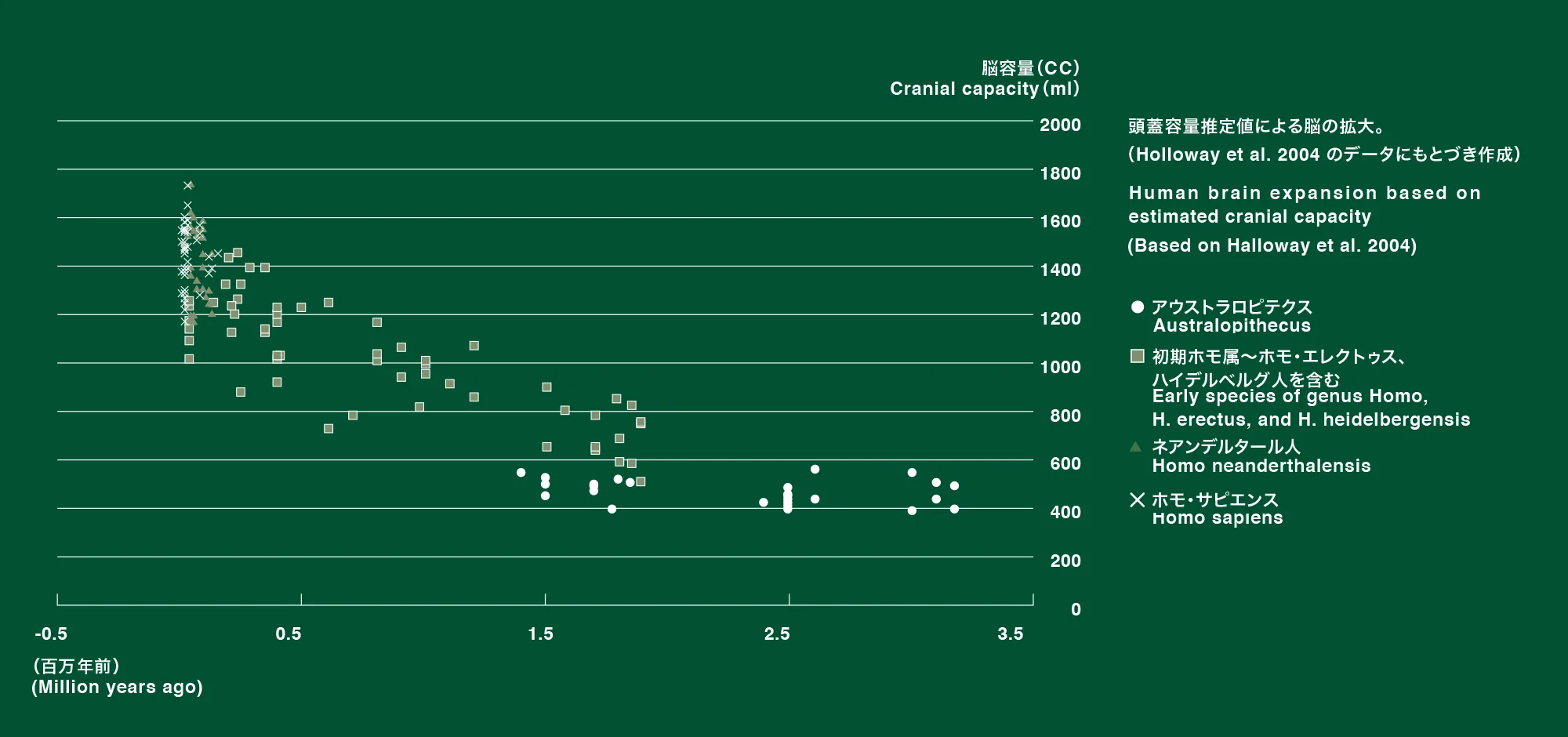
189-11万年前・アフリカからユーラシア大陸、アジア長距離の二足歩行が可能となり、生息範囲が拡がりました。火を使用するようになり、炉は暖をとり捕食者を退けるのみならず、食物を調理し分かち合うなど、コミュニケーションの場でもありました。
1.89 million – 110 thousand years ago; Africa, Eurasian Continent and Asia
Long-distance bipedal walking became possible, expanding the habitat. The use of fire began, and furnaces became a place of communication, such as cooking and sharing food, in addition to providing warmth and scaring off predators.
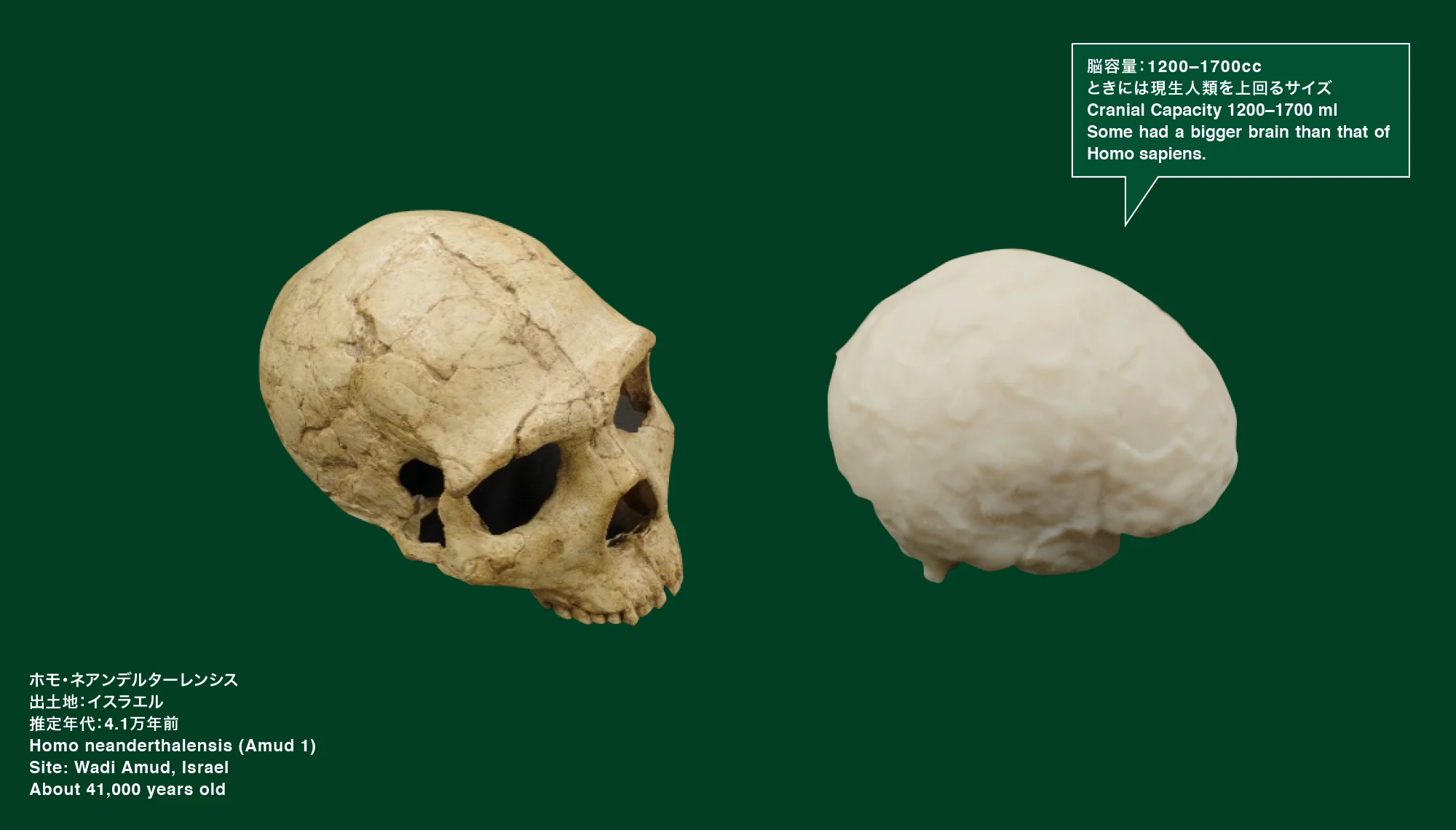
ネアンデルタール人(旧人) Homo neanderthalensis
- 2-1b-3.webm
40-4万年前・ヨーロッパ
原人から進化した種のひとつで、現在のヒトに最も近い絶滅人類です。大型の中顔面、傾いた頬骨、巨大な鼻を持ち、短く太い体幹は寒冷環境への適応と考えられます。岩陰に棲み、大型獣を狩り、毛皮などで体を包み、装身具も使用していました。死者を丁寧に埋葬するなど、象徴的な思考と行動が可能でした。400-40 thousand years ago; Europe
One of the species that evolved from Homo erectus, they are extinct but are closest to the present humans. With the large face midface, angled cheek bones, and massive nose, Homo neanderthalensis were well adapted to cold climates with their short and thick trunks. They used rocks as shelter, hunted large animals, and covered their bodies with fur and accessories. The dead were buried with care, indicating that Homo neanderthalensis were capable of symbolic thoughts and behavior.
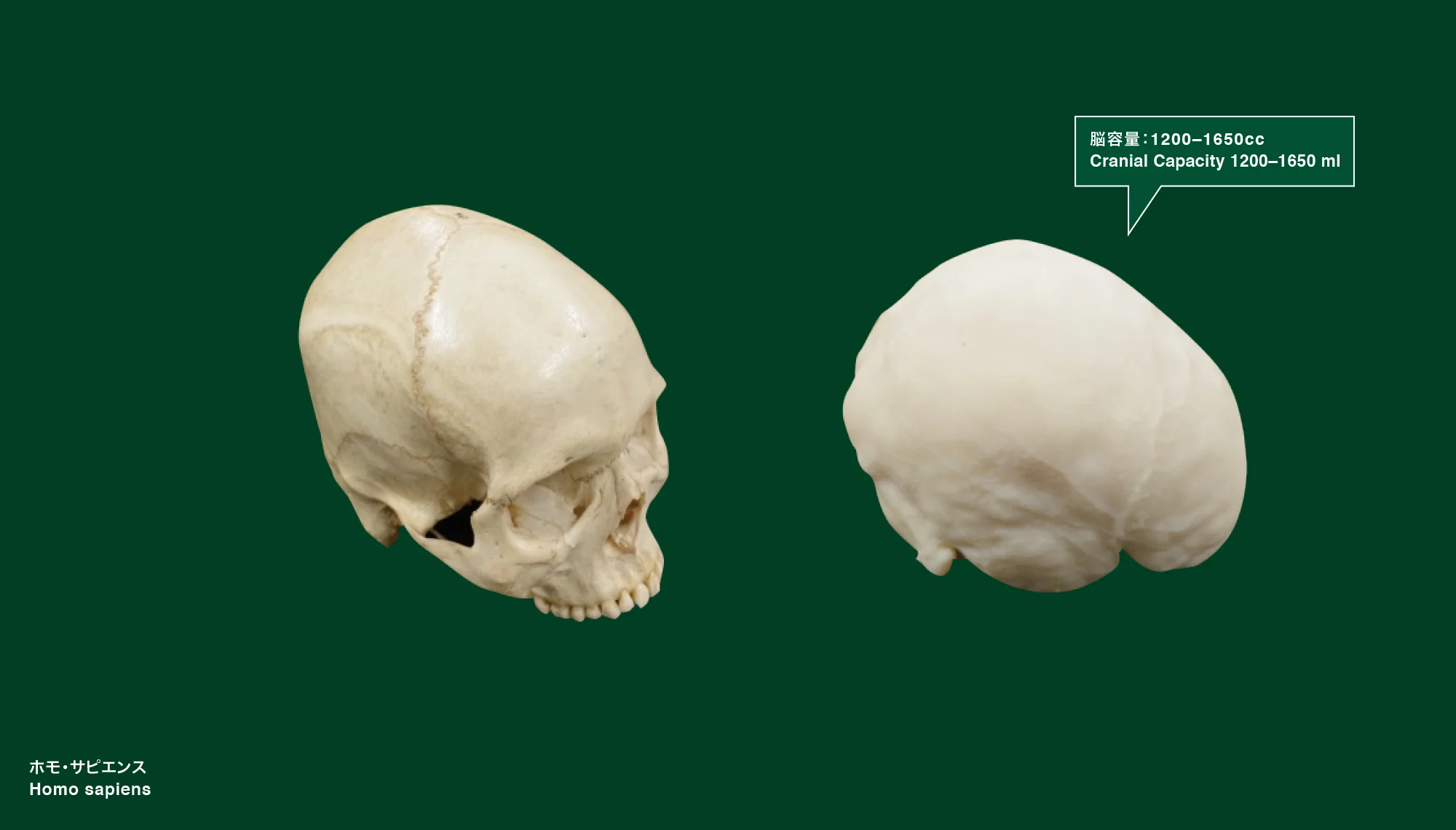
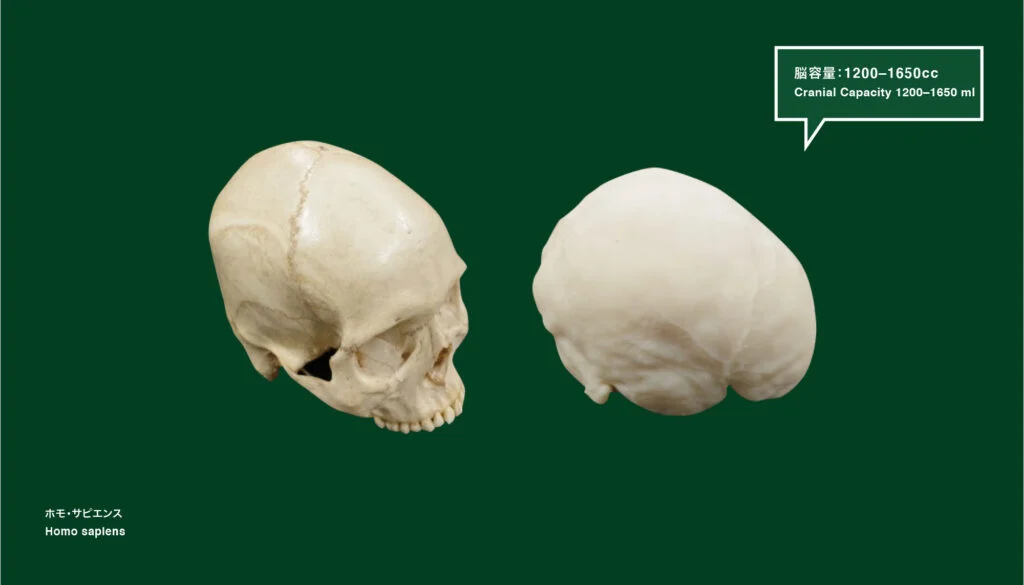
ホモ・サピエンス(新人) Homo sapiens
- 2-1b-4.webm
30万年前-現在・全世界
私たちホモ・サピエンスは、約30万年前にアフリカで誕生し、世界各地に広がりました。他の人類種と同様、狩猟・採集を生業としていましたが、行動を進化させ、氷河期を生き残りました。地域を越えて資源を交換するなど、広範囲にわたるネットワークを構築し、儀式や芸術表現など、複雑で象徴的な行為もみられました。We, Homo sapiens, were born in Africa about 300,000 years ago, and then spread around the world. Similar to other humans, Homo sapiens were hunters and gatherers, but we evolved our behaviors and survived the Ice Age. We created a wide extent of network, such as exchanging resources across regions, and presented complex and symbolic actions, such as rituals and artistic expressions.
発音器官の発達
- 2-1d.webm
猿人は、平らな鼻、強く突き出た顎をもち、類人猿的な顔つきをしていました。下顎骨から復元された舌の形は、現在のヒトとは少し違っています。
Australopithecines had a flat nose, strongly protruding jaw, and an ape-like face. The shape of the tongue reconstructed from a mandible is slightly different from modern humans.
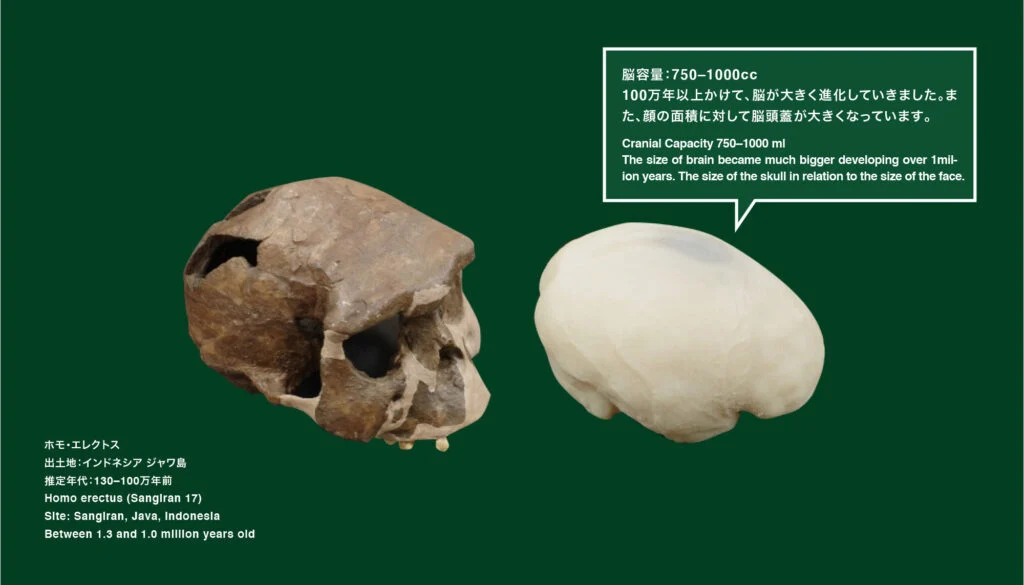
ホモ・エレクトゥス Homo erectus (Dmanisi Skull 3)
- 2-1d.webm
唇からのどに比べて、のどから声帯の長さが短く、出せる声の種類が限られていました。現代人の幼児やチンパンジーに近い形状です。
Compared to the length from the lips to the throat (oral cavity), the length from the throat to the vocal cords (pharynx) was short, limiting the type of sounds they could generate. It was similar to modern infants and chimpanzees.
ホモ・ハイデルベルゲンシス Homo heidelbergensis (Atapuerca 5)
- 2-1d.webm
唇からのどと、のどから声帯の長さが、ほぼ同じになりました。のどの奥の形を、より自由に変えられるようになりました。
The length from the lips to the throat (oral cavity) and the length from the throat to the vocal cords (pharynx) became almost the same. The shape of the back of the throat could be changed more freely.
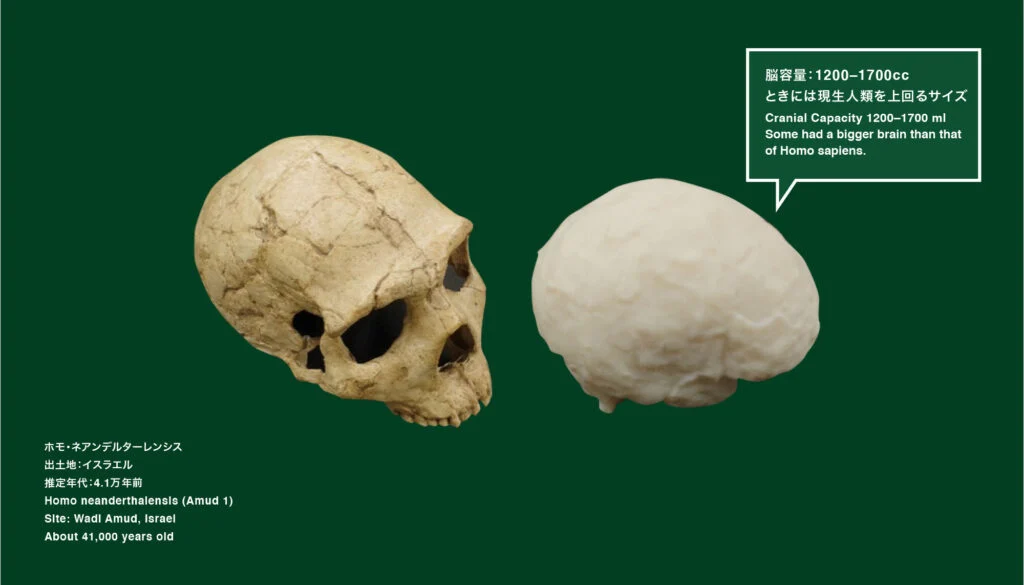
ネアンデルタール人 Homo neanderthalensis (Amud 1)
- 2-1d.webm
現代人と比べると、唇からのどがやや長くなっています。舌が大きいことから、母音については、現代人と同様の発音能力があったと推測できます。
Compared to modern humans, the length from the lips to the throat (oral cavity) was slightly longer. Since the tongue was large, vowels were probably pronounced as well as by modern humans.
ホモ・サピエンス Homo sapiens (Cro-Magnon 1)
- 2-1d.webm
解剖学的には現代人と同じです。母音のみでなく子音についても現代人と同じように発音できたと考えられます。
Anatomically, they were the same as modern humans. It is most likely that not only vowels but consonants were pronounced just like modern humans.
ホモ・サピエンス(現代人・女性) Homo sapiens (Modern human, woman)
- 2-1d.webm
現代人は、「つ」の字状の舌を備えた口腔構造をもっており、複雑な調音をすることができます。これを駆使して、音声言語を発音しています。
Modern humans have an oral cavity structure with a tongue in the shape of a hiragana “tsu”, which allows complex articulations.
上肢の発達 1
- 2-1e.webm
猿人は、樹上生活に適応した長い腕と湾曲した指をもっていました。骨盤と足の骨はヒトに似ており、直立二足歩行が可能でした。
Australopithecines had long arms and curved fingers well suited for a life in trees. The pelvis and foot bones were similar to modern humans, allowing for bipedalism.
上肢の発達 2
- 2-1e.webm
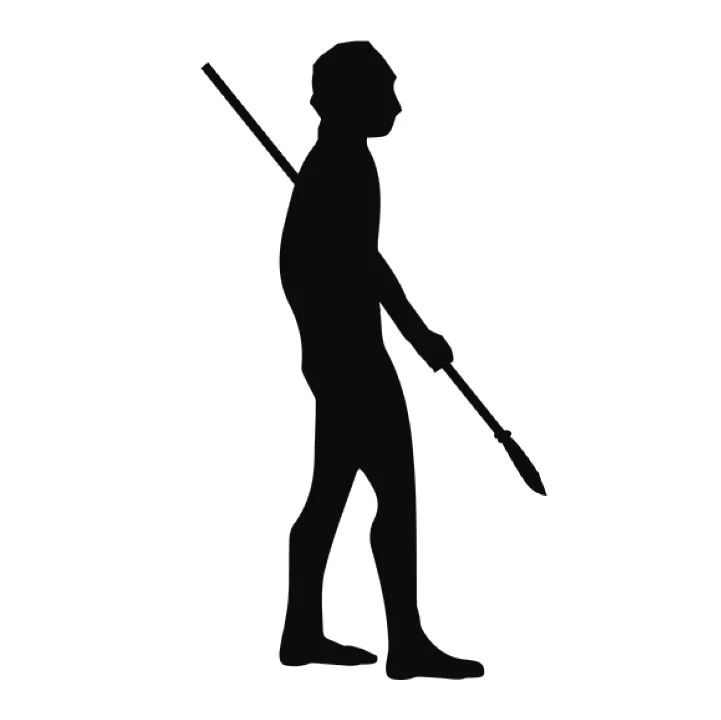
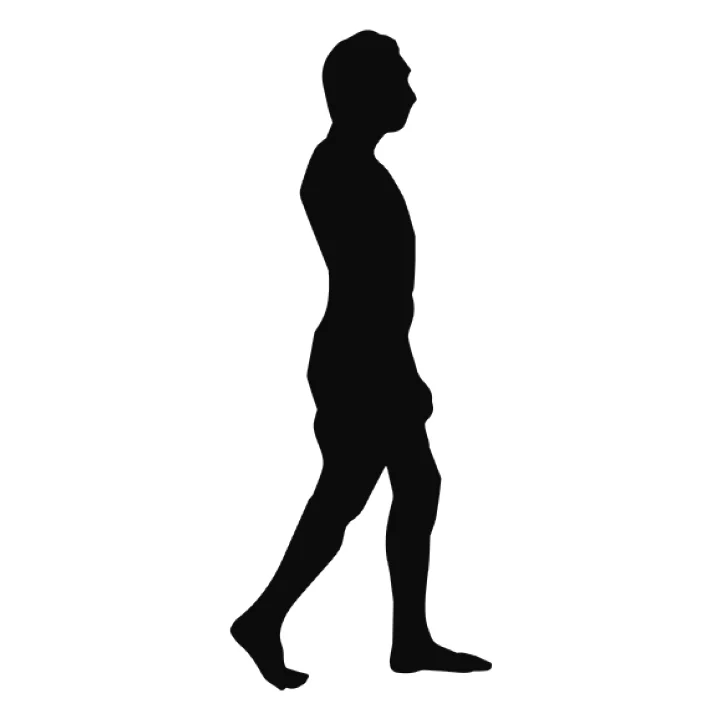
体幹に対して、腕は短く脚は長い、という、現生人類と似た体つきになります。長距離の二足歩行が可能になり、上肢を移動に使用する必要がなくなりました。これにより、道具の製作や運搬、コミュニケーションなど、様々な目的に利用できるようになりました。
They had a similar body to modern humans where their arms were longer than the trunk while legs were longer than the trunk. Long-distance bipedal walking became possible, and arms were no longer needed for transportation. As such, arms became available for various purposes such as manufacturing and transportation of tools, and communication.
上肢の発達 3
- 2-1e.webm
頑丈な手の骨格を持ち、手全体を使ってものをつかむことにより、道具作りをしたと考えられてきました。近年の手の筋肉に関する研究では、親指や人差し指の先端を使った精密把握によって精巧な石器作りをしていたことが解っています。
With sturdy bone structure for the hands, they were able to hold objects with their whole hands. This allowed the manufacturing of tools. In recent studies on hand muscles, it was shown that elaborate stone tools were created through precise grasps between the thumb and tip of the index finger.
上肢の発達 4
- 2-1e.webm
先行する化石人類種よりきゃしゃな骨格になりました。
Their frame became less sturdy than previous fossil hominids.
上肢の発達 5
- 2-1e.webm
現代人は、直立した上体と両腕・両手を、生物として必要な営みに使うだけでなく、顔の表情と合わせてコミュニケーションにも活用しています。
Modern humans not only use the arms and hands freed by bipedalism for necessary activities as living organisms but also for communication in combination with facial expressions.
礫器(れっき) Chopping stone tools
- 2-1f.webm
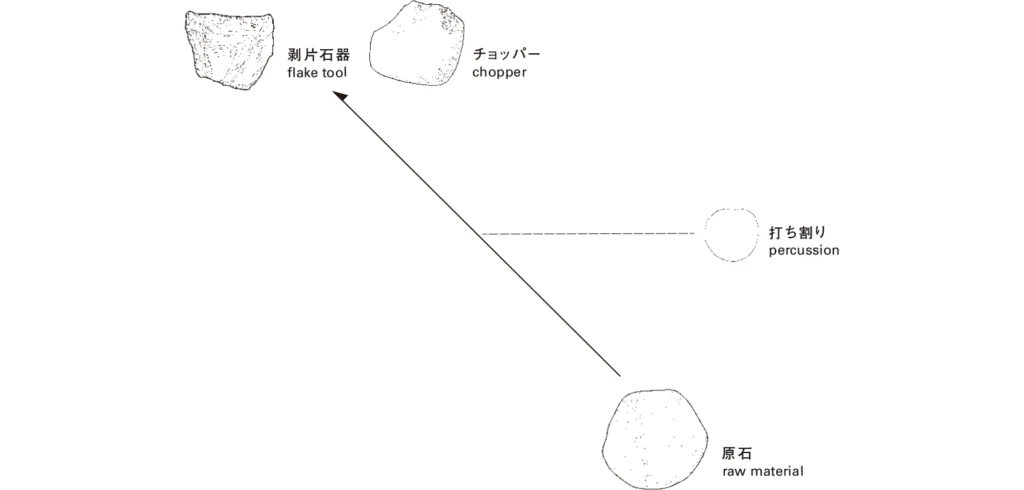
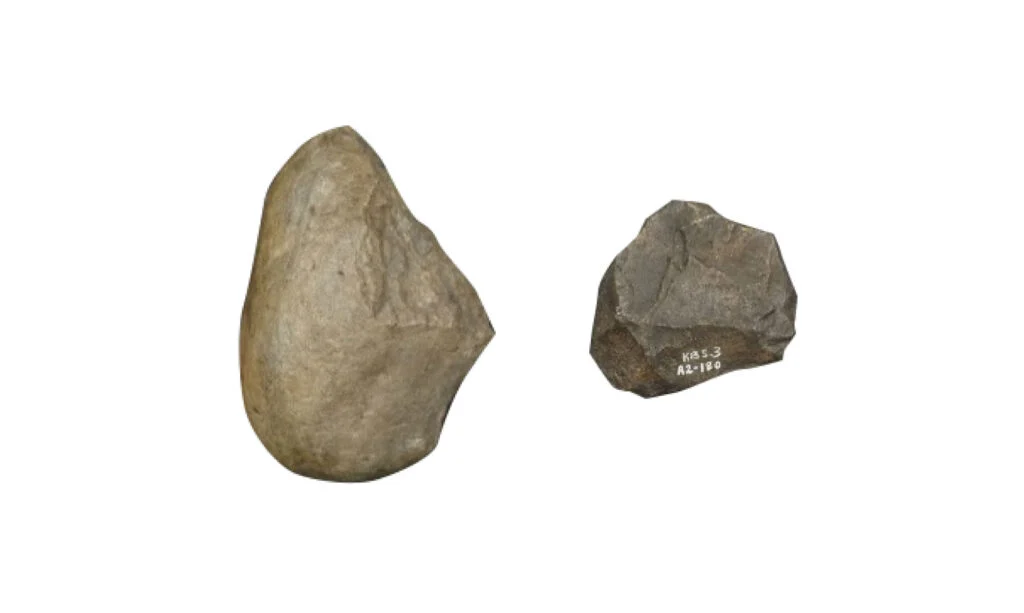
ホモ・ハビリスは、礫を少しだけ打ち欠いた簡単な道具を作っていました。
Choppers and Chopping Tools
Homo habilis used simple stone tools made with hammerstones struck against more angular rocks to strike off sharp flakes.
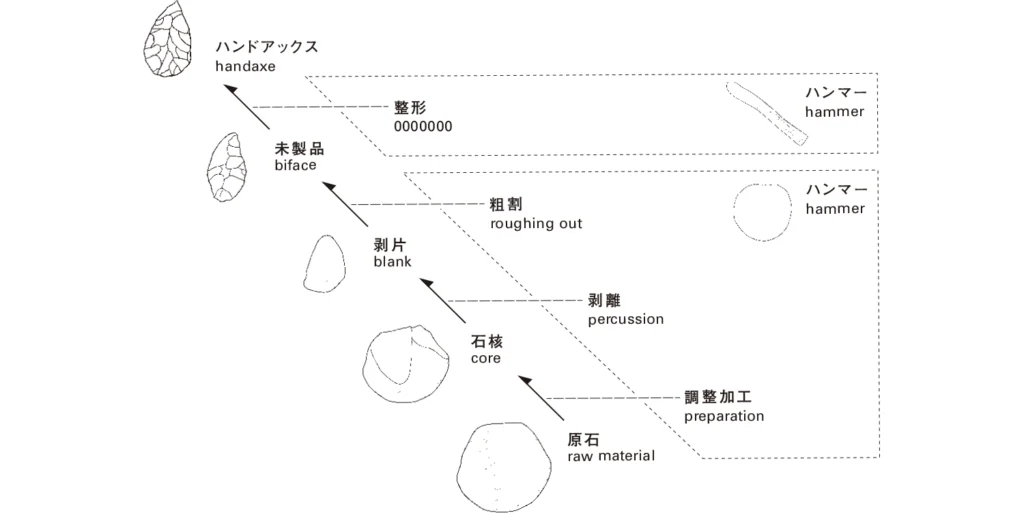
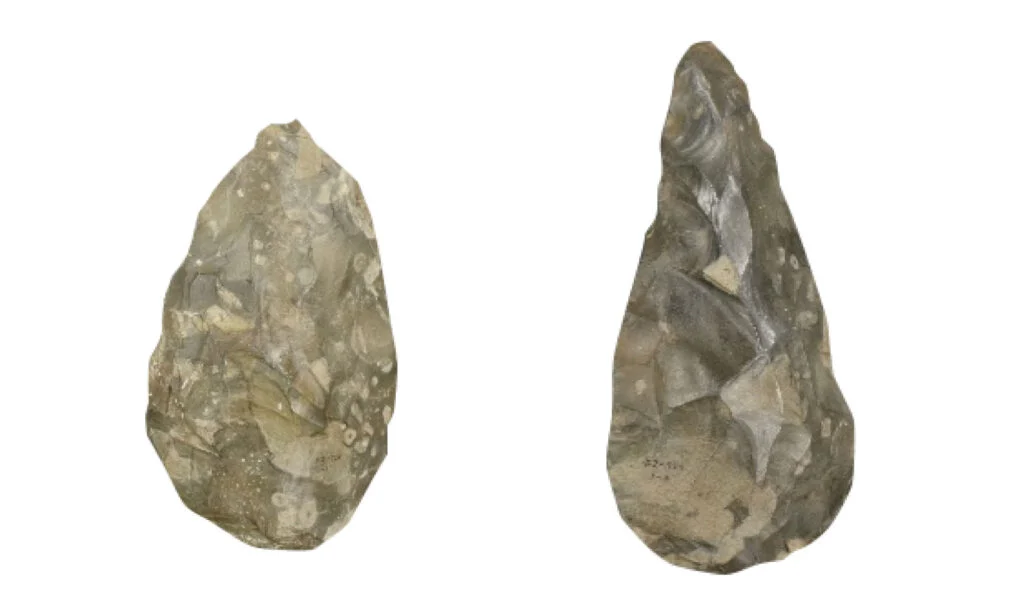
握り斧(ハンドアックス) Hand axe
- 2-1f.webm
先端を尖らせた規格的な形態をしています。完成形を予測した上で、精密な打撃で形を整えていったことがわかります。複雑な道具の作り方を学習し、伝達することができたと思われます。
It has a regular shape with a sharpened tip. After predicting the completed shape, it was shaped with precise blows. It indicates that it was possible to learn how to make complex tools and share such information.
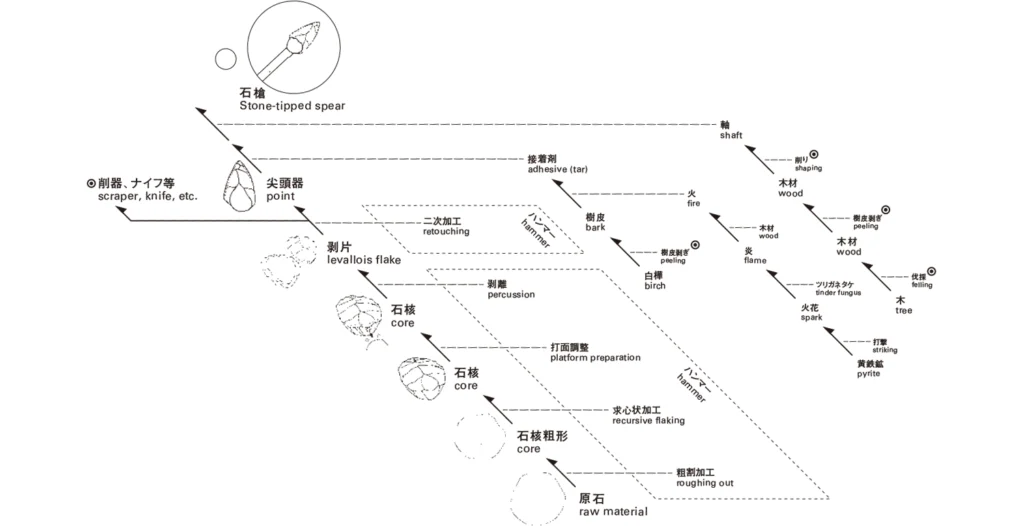
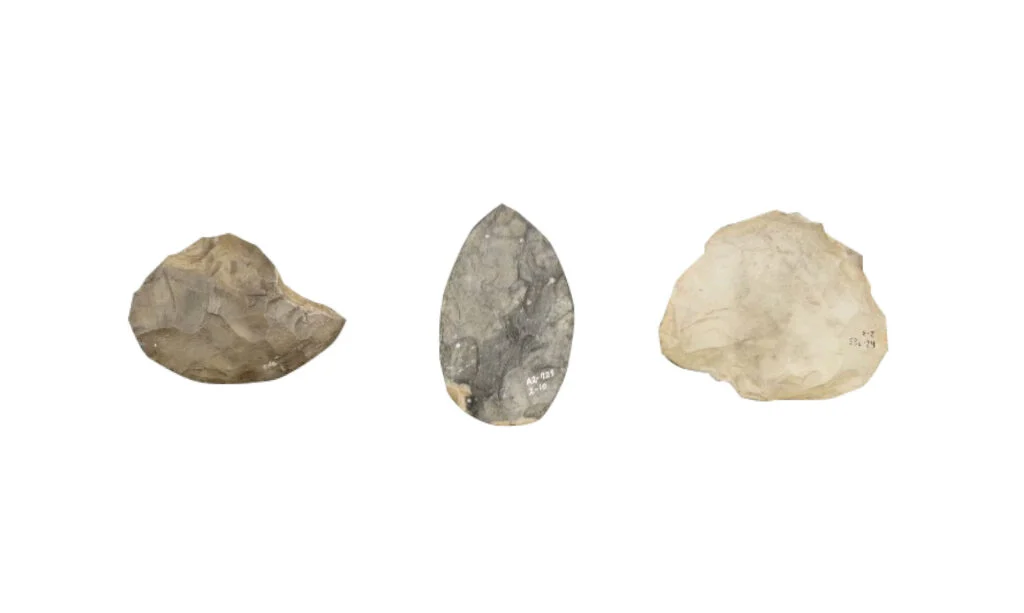
ムステリアン石器 Mousterian stone tools
- 2-1f.webm
石核から定型的な剥片(はくへん)を作り出し、その剥片を槍先などに加工します。また、石の刃と木の柄を組み合わせて、槍として使用していました。
Regular-shaped flakes were created from a core, where these flakes were processed into spearheads. Stone blades and wooden handle were combined to make spears.
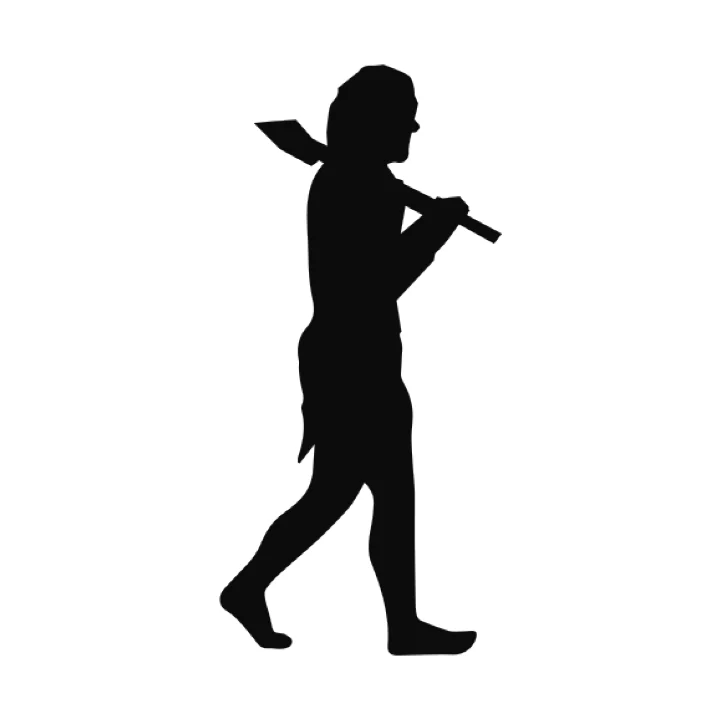
ホモ・サピエンスの石器 Stone tools used by Homo sapiens
- 2-1f.webm
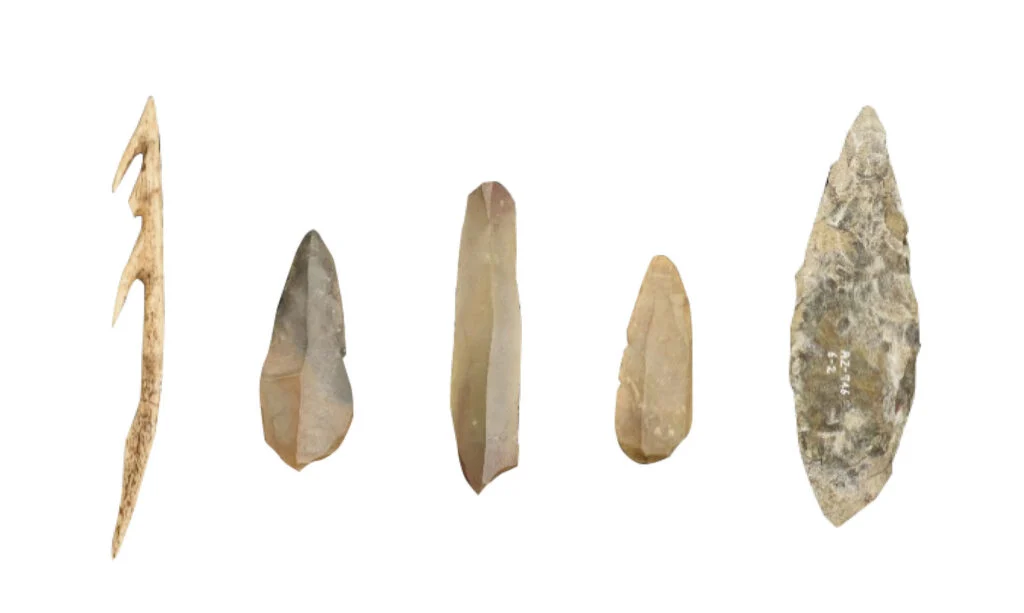
石の塊からたくさんの定型的剥片を得る、効率的な技術が発達します。剥片は槍先・錐・彫器など用途に合わせて仕上げます。さらに、こうした石器を用いて骨を加工し、釣り針や銛、縫い針などができます。道具を組み合わせて使用し、さらに新しい道具を作ることができるようになり、弓矢や投槍器などが使われるようになりました。
An efficient technique that makes many standard flakes from rocks developed. Flakes were finished as spearheads, gimlets, carving tools, and so on, depending on the usage. Furthermore, bones were processed with these stone tools to create fishing hooks, harpoons, and sewing needles. Tools were combined to create new tools, such as bow and arrow and spear throwers.
道具や制作工程には、
どんな特徴があるかな? What kind of characteristics
do you find in tools and their
making of modern human?

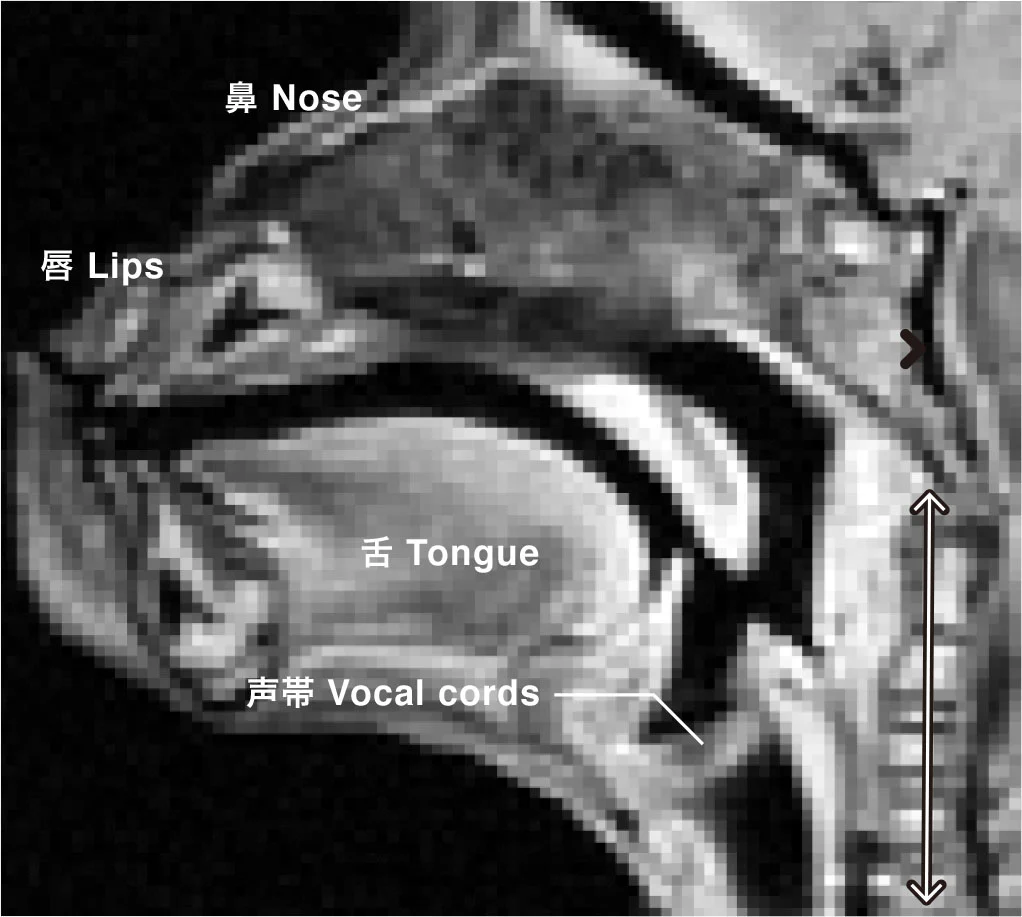
Magnetic resonance imaging photo of chimpanzee
京都大学ヒト行動進化研究センター Digital Morphology Museum 提供の画像に基づき制作
Based on a MRI photo provided by the Digital Morphology Museum, Center for the Evolutionary Origins of Human Behavior (EHUB), Kyoto University
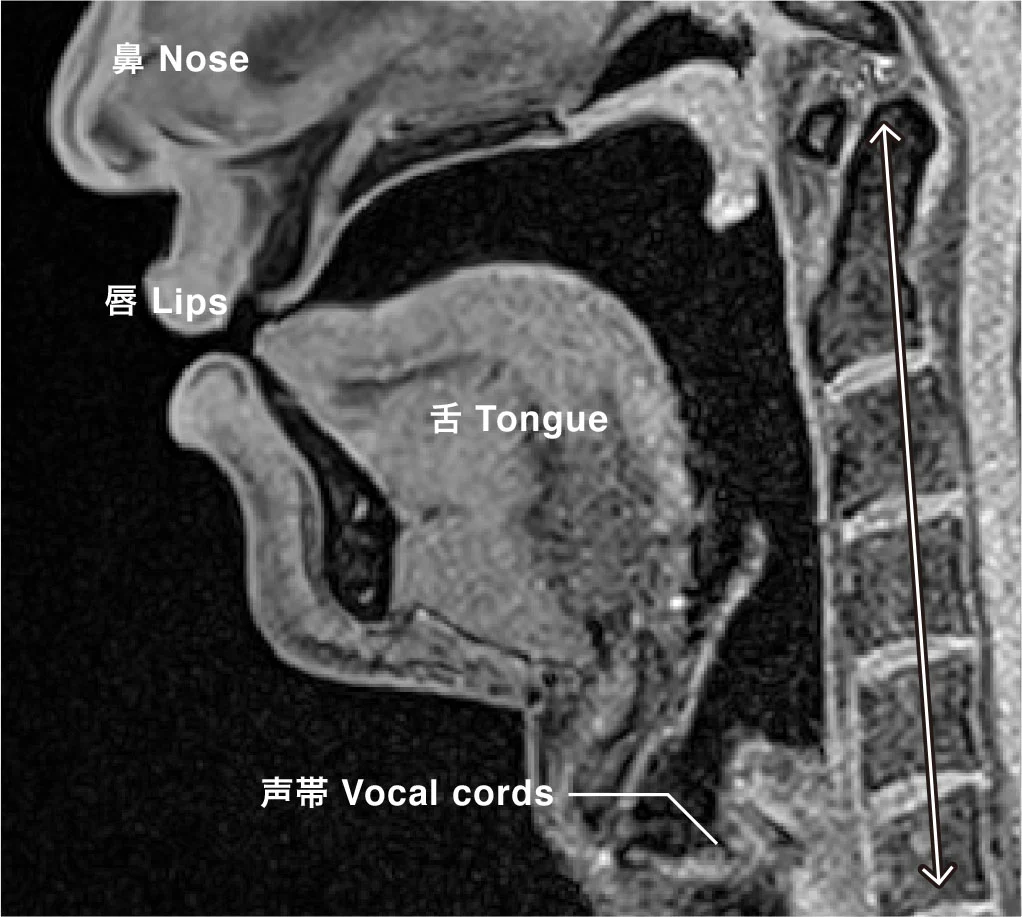
Magnetic resonance imaging photo of human
画像提供:大阪大学
Provided by Osaka University
協力:野崎一徳、吉永司
Contributed by: Nozaki Kazunori, Yohinaga Tsukasa
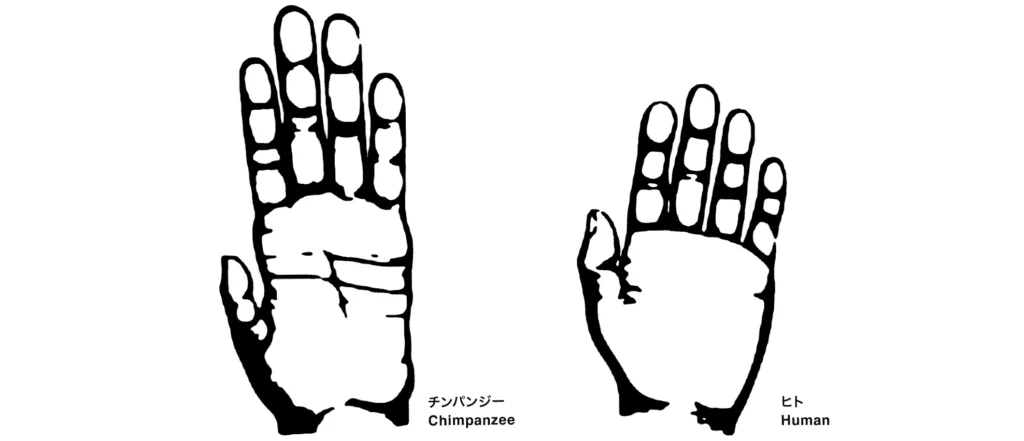
https://doi.org/10.1038/ncomms8717 より引用
https://creativecommons.org/licenses/by/4.0/
協力:野崎一徳、吉永司
Contributed by: Nozaki Kazunori, Yohinaga Tsukasa

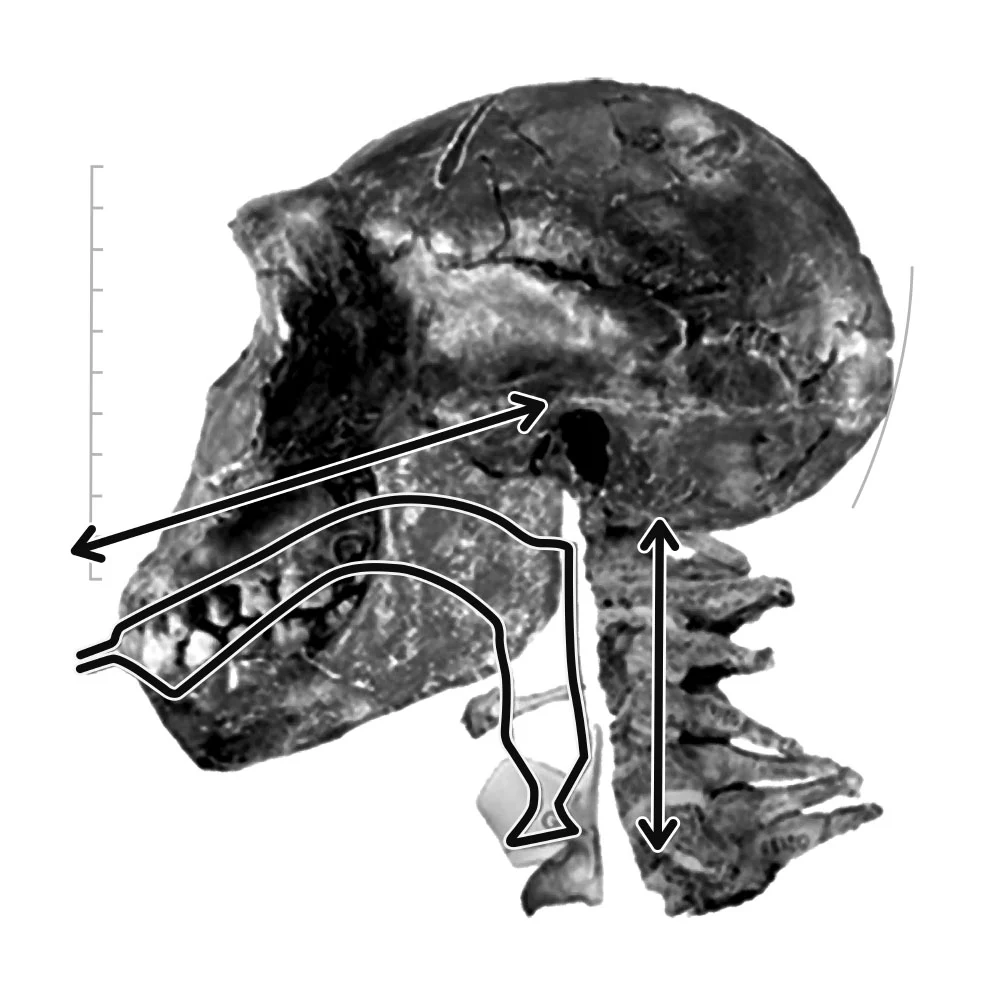
ホモ・エレクトゥス
出土地:ジョージア ドマニシ
約160万年前
Homo erectus (Dmanisi Skull 3)
Site: Dmanisi, Kvemo Kartli, Georgia
About 1.6 million years old
“Reconstructed fossil vocal tracts and the production of speech” -Boë, J.-L. et al.
“New Perspectives on the Origins of Language” -Lefebvre, C. et al. -2013-John Benjamins Publishing Company.
https://benjamins.com/catalog/slcs.144
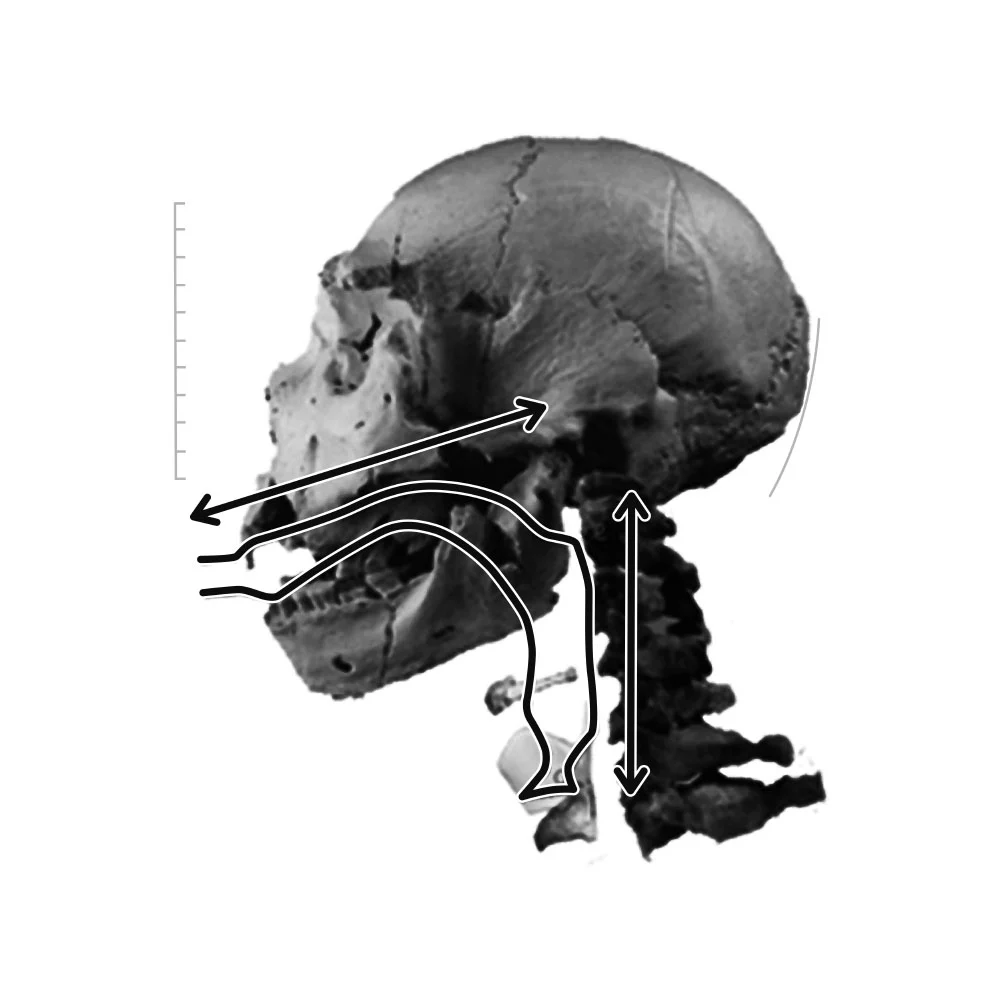
ホモ・ハイデルベルゲンシス
出土地:スペイン アタプエルカ
約35万年前
Homo heidelbergensis (Atapuerca 5)
Site: Atapuerca, Burgos, Spain
About 350,000 years old
“Reconstructed fossil vocal tracts and the production of speech” -Boë, J.-L. et al.
“New Perspectives on the Origins of Language” -Lefebvre, C. et al. -2013-John Benjamins Publishing Company.
https://benjamins.com/catalog/slcs.144
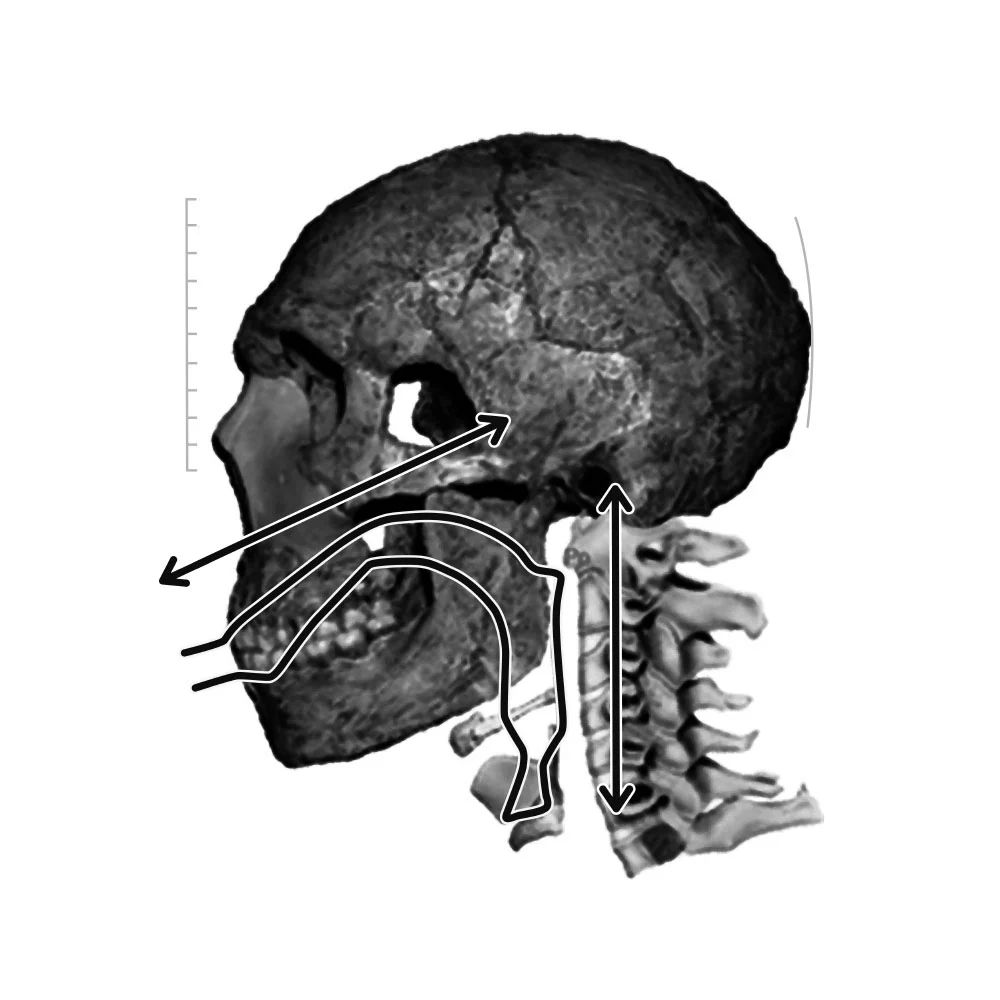
ネアンデルタール人
出土地:イスラエル アムッド洞窟
約4万5千年前
Homo neanderthalensis (Amud 1)
Site: Amud, Upper Galilee, Israel
About 45,000 years old
“Reconstructed fossil vocal tracts and the production of speech” -Boë, J.-L. et al.
“New Perspectives on the Origins of Language” -Lefebvre, C. et al. -2013-John Benjamins Publishing Company.
https://benjamins.com/catalog/slcs.144
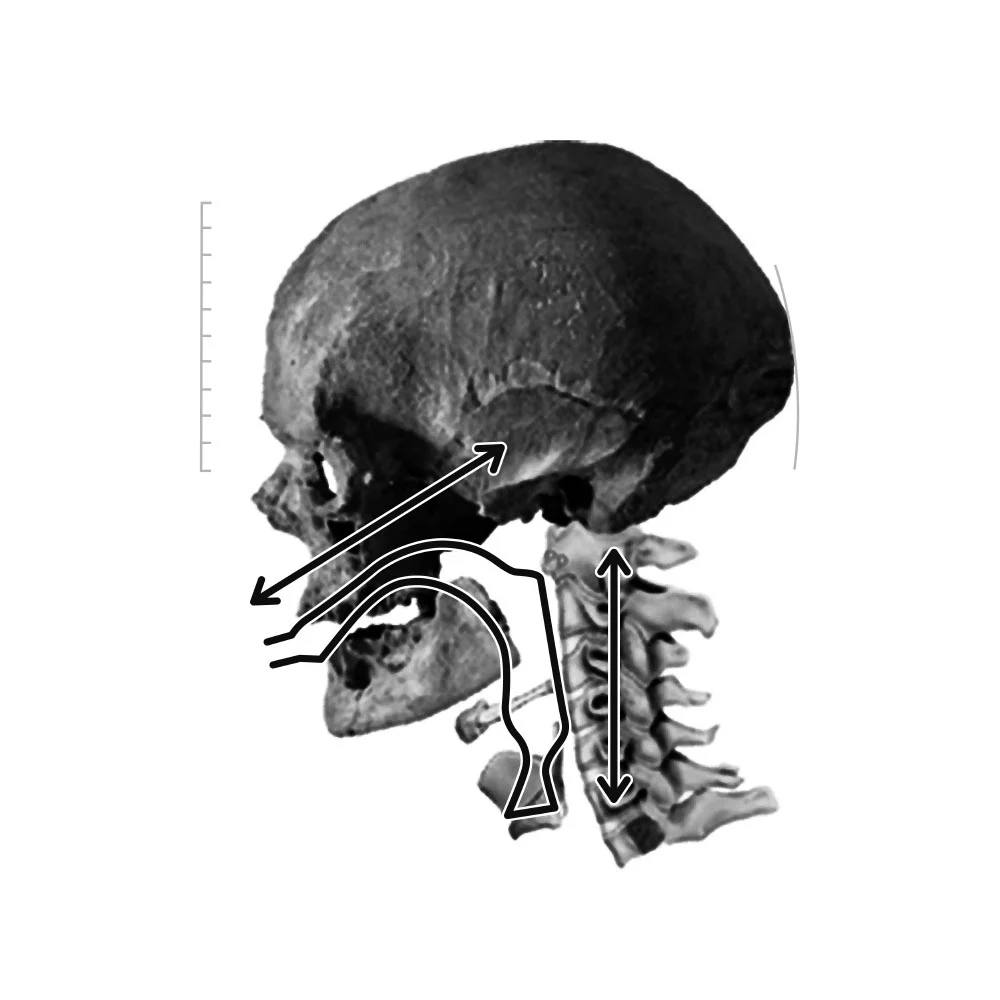
ホモ・サピエンス
出土地:フランス クロマニョン洞窟
約3万年前
Homo sapiens (Cro-Magnon 1)
Site: Cro-Magnon, Les-Eyzies, France
About 30,000 years old
“Reconstructed fossil vocal tracts and the production of speech” -Boë, J.-L. et al.
“New Perspectives on the Origins of Language” -Lefebvre, C. et al. -2013-John Benjamins Publishing Company.
https://benjamins.com/catalog/slcs.144
ホモ・サピエンス
(現代人・女性)
Homo sapiens
(Modern human, woman)
“Reconstructed fossil vocal tracts and the production of speech” -Boë, J.-L. et al.
“New Perspectives on the Origins of Language” -Lefebvre, C. et al. -2013-John Benjamins Publishing Company.
https://benjamins.com/catalog/slcs.144
Prepared by Sano Katsuhiro
Prepared by Sano Katsuhiro
These stone tools are used for processing other materials such as wood.
制作:佐野勝宏
Prepared by Sano Katsuhiro
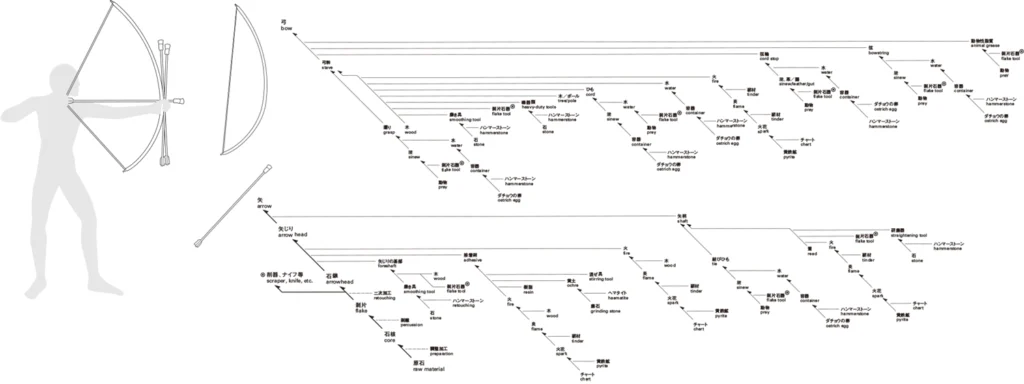
These stone tools are used for processing other materials such as wood.
Lombard and Wadley 2016, Fig.19.3を参考に作成Stone tools used by Homo sapiens
制作:佐野勝宏
Prepared by Sano Katsuhiro
協力:近藤修(東京大学)、佐野勝宏、野崎一徳、野嶋洋子、林美里
Contributed by Kondo Osamu (Tokyo University), Sano Katsuhiro, Nozaki Kazunori, Nojima Yoko, Hayashi Misato
標本提供:国立科学博物館
Artifacts are from the National Museum of Nature and Science Collection
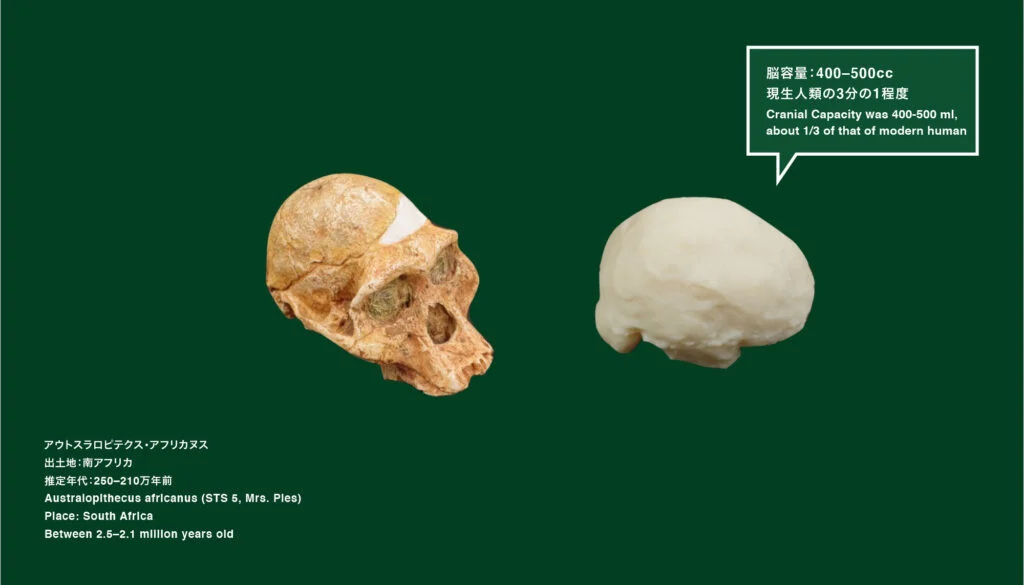
猿人は、平らな鼻、強く突き出た顎をもち、類人猿的な顔つきをしていました。下顎骨から復元された舌の形は、現在のヒトとは少し違っています。
Australopithecines had a flat nose, strongly protruding jaw, and an ape-like face. The shape of the tongue reconstructed from a mandible is slightly different from modern humans.
ホモ・エレクトゥス
出土地:ジョージア ドマニシ
約160万年前
Homo erectus (Dmanisi Skull 3)
Site: Dmanisi, Kvemo Kartli, Georgia
About 1.6 million years old
“Reconstructed fossil vocal tracts and the production of speech” -Boë, J.-L. et al.
“New Perspectives on the Origins of Language” -Lefebvre, C. et al. -2013-John Benjamins Publishing Company.
https://benjamins.com/catalog/slcs.144
ホモ・ハイデルベルゲンシス
出土地:スペイン アタプエルカ
約35万年前
Homo heidelbergensis (Atapuerca 5)
Site: Atapuerca, Burgos, Spain
About 350,000 years old
“Reconstructed fossil vocal tracts and the production of speech” -Boë, J.-L. et al.
“New Perspectives on the Origins of Language” -Lefebvre, C. et al. -2013-John Benjamins Publishing Company.
https://benjamins.com/catalog/slcs.144
ネアンデルタール人
出土地:イスラエル アムッド洞窟
約4万5千年前
Homo neanderthalensis (Amud 1)
Site: Amud, Upper Galilee, Israel
About 45,000 years old
“Reconstructed fossil vocal tracts and the production of speech” -Boë, J.-L. et al.
“New Perspectives on the Origins of Language” -Lefebvre, C. et al. -2013-John Benjamins Publishing Company.
https://benjamins.com/catalog/slcs.144
ホモ・サピエンス
出土地:フランス クロマニョン洞窟
約3万年前
Homo sapiens (Cro-Magnon 1)
Site: Cro-Magnon, Les-Eyzies, France
About 30,000 years old
“Reconstructed fossil vocal tracts and the production of speech” -Boë, J.-L. et al.
“New Perspectives on the Origins of Language” -Lefebvre, C. et al. -2013-John Benjamins Publishing Company.
https://benjamins.com/catalog/slcs.144
ホモ・サピエンス
(現代人・女性)
Homo sapiens
(Modern human, woman)
“Reconstructed fossil vocal tracts and the production of speech” -Boë, J.-L. et al.
“New Perspectives on the Origins of Language” -Lefebvre, C. et al. -2013-John Benjamins Publishing Company.
https://benjamins.com/catalog/slcs.144
猿人は、平らな鼻、強く突き出た顎をもち、類人猿的な顔つきをしていました。下顎骨から復元された舌の形は、現在のヒトとは少し違っています。
Australopithecines had a flat nose, strongly protruding jaw, and an ape-like face. The shape of the tongue reconstructed from a mandible is slightly different from modern humans.
ホモ・エレクトゥス
出土地:ジョージア ドマニシ
約160万年前
Homo erectus (Dmanisi Skull 3)
Site: Dmanisi, Kvemo Kartli, Georgia
About 1.6 million years old
“Reconstructed fossil vocal tracts and the production of speech” -Boë, J.-L. et al.
“New Perspectives on the Origins of Language” -Lefebvre, C. et al. -2013-John Benjamins Publishing Company.
https://benjamins.com/catalog/slcs.144
ホモ・ハイデルベルゲンシス
出土地:スペイン アタプエルカ
約35万年前
Homo heidelbergensis (Atapuerca 5)
Site: Atapuerca, Burgos, Spain
About 350,000 years old
“Reconstructed fossil vocal tracts and the production of speech” -Boë, J.-L. et al.
“New Perspectives on the Origins of Language” -Lefebvre, C. et al. -2013-John Benjamins Publishing Company.
https://benjamins.com/catalog/slcs.144
ネアンデルタール人
出土地:イスラエル アムッド洞窟
約4万5千年前
Homo neanderthalensis (Amud 1)
Site: Amud, Upper Galilee, Israel
About 45,000 years old
“Reconstructed fossil vocal tracts and the production of speech” -Boë, J.-L. et al.
“New Perspectives on the Origins of Language” -Lefebvre, C. et al. -2013-John Benjamins Publishing Company.
https://benjamins.com/catalog/slcs.144
ホモ・サピエンス
出土地:フランス クロマニョン洞窟
約3万年前
Homo sapiens (Cro-Magnon 1)
Site: Cro-Magnon, Les-Eyzies, France
About 30,000 years old
“Reconstructed fossil vocal tracts and the production of speech” -Boë, J.-L. et al.
“New Perspectives on the Origins of Language” -Lefebvre, C. et al. -2013-John Benjamins Publishing Company.
https://benjamins.com/catalog/slcs.144
ホモ・サピエンス
(現代人・女性)
Homo sapiens
(Modern human, woman)
“Reconstructed fossil vocal tracts and the production of speech” -Boë, J.-L. et al.
“New Perspectives on the Origins of Language” -Lefebvre, C. et al. -2013-John Benjamins Publishing Company.
https://benjamins.com/catalog/slcs.144
猿人は、平らな鼻、強く突き出た顎をもち、類人猿的な顔つきをしていました。下顎骨から復元された舌の形は、現在のヒトとは少し違っています。
Australopithecines had a flat nose, strongly protruding jaw, and an ape-like face. The shape of the tongue reconstructed from a mandible is slightly different from modern humans.
ホモ・エレクトゥス
出土地:ジョージア ドマニシ
約160万年前
Homo erectus (Dmanisi Skull 3)
Site: Dmanisi, Kvemo Kartli, Georgia
About 1.6 million years old
“Reconstructed fossil vocal tracts and the production of speech” -Boë, J.-L. et al.
“New Perspectives on the Origins of Language” -Lefebvre, C. et al. -2013-John Benjamins Publishing Company.
https://benjamins.com/catalog/slcs.144
ホモ・ハイデルベルゲンシス
出土地:スペイン アタプエルカ
約35万年前
Homo heidelbergensis (Atapuerca 5)
Site: Atapuerca, Burgos, Spain
About 350,000 years old
“Reconstructed fossil vocal tracts and the production of speech” -Boë, J.-L. et al.
“New Perspectives on the Origins of Language” -Lefebvre, C. et al. -2013-John Benjamins Publishing Company.
https://benjamins.com/catalog/slcs.144
ネアンデルタール人
出土地:イスラエル アムッド洞窟
約4万5千年前
Homo neanderthalensis (Amud 1)
Site: Amud, Upper Galilee, Israel
About 45,000 years old
“Reconstructed fossil vocal tracts and the production of speech” -Boë, J.-L. et al.
“New Perspectives on the Origins of Language” -Lefebvre, C. et al. -2013-John Benjamins Publishing Company.
https://benjamins.com/catalog/slcs.144
ホモ・サピエンス
出土地:フランス クロマニョン洞窟
約3万年前
Homo sapiens (Cro-Magnon 1)
Site: Cro-Magnon, Les-Eyzies, France
About 30,000 years old
“Reconstructed fossil vocal tracts and the production of speech” -Boë, J.-L. et al.
“New Perspectives on the Origins of Language” -Lefebvre, C. et al. -2013-John Benjamins Publishing Company.
https://benjamins.com/catalog/slcs.144
ホモ・サピエンス
(現代人・女性)
Homo sapiens
(Modern human, woman)
“Reconstructed fossil vocal tracts and the production of speech” -Boë, J.-L. et al.
“New Perspectives on the Origins of Language” -Lefebvre, C. et al. -2013-John Benjamins Publishing Company.
https://benjamins.com/catalog/slcs.144
猿人は、平らな鼻、強く突き出た顎をもち、類人猿的な顔つきをしていました。下顎骨から復元された舌の形は、現在のヒトとは少し違っています。
Australopithecines had a flat nose, strongly protruding jaw, and an ape-like face. The shape of the tongue reconstructed from a mandible is slightly different from modern humans.
ホモ・エレクトゥス
出土地:ジョージア ドマニシ
約160万年前
Homo erectus (Dmanisi Skull 3)
Site: Dmanisi, Kvemo Kartli, Georgia
About 1.6 million years old
“Reconstructed fossil vocal tracts and the production of speech” -Boë, J.-L. et al.
“New Perspectives on the Origins of Language” -Lefebvre, C. et al. -2013-John Benjamins Publishing Company.
https://benjamins.com/catalog/slcs.144
ホモ・ハイデルベルゲンシス
出土地:スペイン アタプエルカ
約35万年前
Homo heidelbergensis (Atapuerca 5)
Site: Atapuerca, Burgos, Spain
About 350,000 years old
“Reconstructed fossil vocal tracts and the production of speech” -Boë, J.-L. et al.
“New Perspectives on the Origins of Language” -Lefebvre, C. et al. -2013-John Benjamins Publishing Company.
https://benjamins.com/catalog/slcs.144
ネアンデルタール人
出土地:イスラエル アムッド洞窟
約4万5千年前
Homo neanderthalensis (Amud 1)
Site: Amud, Upper Galilee, Israel
About 45,000 years old
“Reconstructed fossil vocal tracts and the production of speech” -Boë, J.-L. et al.
“New Perspectives on the Origins of Language” -Lefebvre, C. et al. -2013-John Benjamins Publishing Company.
https://benjamins.com/catalog/slcs.144
ホモ・サピエンス
出土地:フランス クロマニョン洞窟
約3万年前
Homo sapiens (Cro-Magnon 1)
Site: Cro-Magnon, Les-Eyzies, France
About 30,000 years old
“Reconstructed fossil vocal tracts and the production of speech” -Boë, J.-L. et al.
“New Perspectives on the Origins of Language” -Lefebvre, C. et al. -2013-John Benjamins Publishing Company.
https://benjamins.com/catalog/slcs.144
ホモ・サピエンス
(現代人・女性)
Homo sapiens
(Modern human, woman)
“Reconstructed fossil vocal tracts and the production of speech” -Boë, J.-L. et al.
“New Perspectives on the Origins of Language” -Lefebvre, C. et al. -2013-John Benjamins Publishing Company.
https://benjamins.com/catalog/slcs.144
猿人は、平らな鼻、強く突き出た顎をもち、類人猿的な顔つきをしていました。下顎骨から復元された舌の形は、現在のヒトとは少し違っています。
Australopithecines had a flat nose, strongly protruding jaw, and an ape-like face. The shape of the tongue reconstructed from a mandible is slightly different from modern humans.
ホモ・エレクトゥス
出土地:ジョージア ドマニシ
約160万年前
Homo erectus (Dmanisi Skull 3)
Site: Dmanisi, Kvemo Kartli, Georgia
About 1.6 million years old
“Reconstructed fossil vocal tracts and the production of speech” -Boë, J.-L. et al.
“New Perspectives on the Origins of Language” -Lefebvre, C. et al. -2013-John Benjamins Publishing Company.
https://benjamins.com/catalog/slcs.144
ホモ・ハイデルベルゲンシス
出土地:スペイン アタプエルカ
約35万年前
Homo heidelbergensis (Atapuerca 5)
Site: Atapuerca, Burgos, Spain
About 350,000 years old
“Reconstructed fossil vocal tracts and the production of speech” -Boë, J.-L. et al.
“New Perspectives on the Origins of Language” -Lefebvre, C. et al. -2013-John Benjamins Publishing Company.
https://benjamins.com/catalog/slcs.144
ネアンデルタール人
出土地:イスラエル アムッド洞窟
約4万5千年前
Homo neanderthalensis (Amud 1)
Site: Amud, Upper Galilee, Israel
About 45,000 years old
“Reconstructed fossil vocal tracts and the production of speech” -Boë, J.-L. et al.
“New Perspectives on the Origins of Language” -Lefebvre, C. et al. -2013-John Benjamins Publishing Company.
https://benjamins.com/catalog/slcs.144
ホモ・サピエンス
出土地:フランス クロマニョン洞窟
約3万年前
Homo sapiens (Cro-Magnon 1)
Site: Cro-Magnon, Les-Eyzies, France
About 30,000 years old
“Reconstructed fossil vocal tracts and the production of speech” -Boë, J.-L. et al.
“New Perspectives on the Origins of Language” -Lefebvre, C. et al. -2013-John Benjamins Publishing Company.
https://benjamins.com/catalog/slcs.144
ホモ・サピエンス
(現代人・女性)
Homo sapiens
(Modern human, woman)
“Reconstructed fossil vocal tracts and the production of speech” -Boë, J.-L. et al.
“New Perspectives on the Origins of Language” -Lefebvre, C. et al. -2013-John Benjamins Publishing Company.
https://benjamins.com/catalog/slcs.144
猿人は、平らな鼻、強く突き出た顎をもち、類人猿的な顔つきをしていました。下顎骨から復元された舌の形は、現在のヒトとは少し違っています。
Australopithecines had a flat nose, strongly protruding jaw, and an ape-like face. The shape of the tongue reconstructed from a mandible is slightly different from modern humans.
ホモ・エレクトゥス
出土地:ジョージア ドマニシ
約160万年前
Homo erectus (Dmanisi Skull 3)
Site: Dmanisi, Kvemo Kartli, Georgia
About 1.6 million years old
“Reconstructed fossil vocal tracts and the production of speech” -Boë, J.-L. et al.
“New Perspectives on the Origins of Language” -Lefebvre, C. et al. -2013-John Benjamins Publishing Company.
https://benjamins.com/catalog/slcs.144
ホモ・ハイデルベルゲンシス
出土地:スペイン アタプエルカ
約35万年前
Homo heidelbergensis (Atapuerca 5)
Site: Atapuerca, Burgos, Spain
About 350,000 years old
“Reconstructed fossil vocal tracts and the production of speech” -Boë, J.-L. et al.
“New Perspectives on the Origins of Language” -Lefebvre, C. et al. -2013-John Benjamins Publishing Company.
https://benjamins.com/catalog/slcs.144
ネアンデルタール人
出土地:イスラエル アムッド洞窟
約4万5千年前
Homo neanderthalensis (Amud 1)
Site: Amud, Upper Galilee, Israel
About 45,000 years old
“Reconstructed fossil vocal tracts and the production of speech” -Boë, J.-L. et al.
“New Perspectives on the Origins of Language” -Lefebvre, C. et al. -2013-John Benjamins Publishing Company.
https://benjamins.com/catalog/slcs.144
ホモ・サピエンス
出土地:フランス クロマニョン洞窟
約3万年前
Homo sapiens (Cro-Magnon 1)
Site: Cro-Magnon, Les-Eyzies, France
About 30,000 years old
“Reconstructed fossil vocal tracts and the production of speech” -Boë, J.-L. et al.
“New Perspectives on the Origins of Language” -Lefebvre, C. et al. -2013-John Benjamins Publishing Company.
https://benjamins.com/catalog/slcs.144
ホモ・サピエンス
(現代人・女性)
Homo sapiens
(Modern human, woman)
“Reconstructed fossil vocal tracts and the production of speech” -Boë, J.-L. et al.
“New Perspectives on the Origins of Language” -Lefebvre, C. et al. -2013-John Benjamins Publishing Company.
https://benjamins.com/catalog/slcs.144
発音器官の発達:協力:野崎一徳、吉永司 / Contributed by: Nozaki Kazunori, Yoshinaga Tsukasa
猿人は、樹上生活に適応した長い腕と湾曲した指をもっていました。骨盤と足の骨はヒトに似ており、直立二足歩行が可能でした。
Australopithecines had long arms and curved fingers well suited for a life in trees. The pelvis and foot bones were similar to modern humans, allowing for bipedalism.
体幹に対して、腕は短く脚は長い、という、現生人類と似た体つきになります。長距離の二足歩行が可能になり、上肢を移動に使用する必要がなくなりました。これにより、道具の製作や運搬、コミュニケーションなど、様々な目的に利用できるようになりました。
They had a similar body to modern humans where their arms were longer than the trunk while legs were longer than the trunk. Long-distance bipedal walking became possible, and arms were no longer needed for transportation. As such, arms became available for various purposes such as manufacturing and transportation of tools, and communication.
頑丈な手の骨格を持ち、手全体を使ってものをつかむことにより、道具作りをしたと考えられてきました。近年の手の筋肉に関する研究では、親指や人差し指の先端を使った精密把握によって精巧な石器作りをしていたことが解っています。
With sturdy bone structure for the hands, they were able to hold objects with their whole hands. This allowed the manufacturing of tools. In recent studies on hand muscles, it was shown that elaborate stone tools were created through precise grasps between the thumb and tip of the index finger.
先行する化石人類種よりきゃしゃな骨格になりました。
Their frame became less sturdy than previous fossil hominids.
現代人は、直立した上体と両腕・両手を、生物として必要な営みに使うだけでなく、顔の表情と合わせてコミュニケーションにも活用しています。
Modern humans not only use the arms and hands freed by bipedalism for necessary activities as living organisms but also for communication in combination with facial expressions.
猿人は、樹上生活に適応した長い腕と湾曲した指をもっていました。骨盤と足の骨はヒトに似ており、直立二足歩行が可能でした。
Australopithecines had long arms and curved fingers well suited for a life in trees. The pelvis and foot bones were similar to modern humans, allowing for bipedalism.
体幹に対して、腕は短く脚は長い、という、現生人類と似た体つきになります。長距離の二足歩行が可能になり、上肢を移動に使用する必要がなくなりました。これにより、道具の製作や運搬、コミュニケーションなど、様々な目的に利用できるようになりました。
They had a similar body to modern humans where their arms were longer than the trunk while legs were longer than the trunk. Long-distance bipedal walking became possible, and arms were no longer needed for transportation. As such, arms became available for various purposes such as manufacturing and transportation of tools, and communication.
頑丈な手の骨格を持ち、手全体を使ってものをつかむことにより、道具作りをしたと考えられてきました。近年の手の筋肉に関する研究では、親指や人差し指の先端を使った精密把握によって精巧な石器作りをしていたことが解っています。
With sturdy bone structure for the hands, they were able to hold objects with their whole hands. This allowed the manufacturing of tools. In recent studies on hand muscles, it was shown that elaborate stone tools were created through precise grasps between the thumb and tip of the index finger.
先行する化石人類種よりきゃしゃな骨格になりました。
Their frame became less sturdy than previous fossil hominids.
現代人は、直立した上体と両腕・両手を、生物として必要な営みに使うだけでなく、顔の表情と合わせてコミュニケーションにも活用しています。
Modern humans not only use the arms and hands freed by bipedalism for necessary activities as living organisms but also for communication in combination with facial expressions.
猿人は、樹上生活に適応した長い腕と湾曲した指をもっていました。骨盤と足の骨はヒトに似ており、直立二足歩行が可能でした。
Australopithecines had long arms and curved fingers well suited for a life in trees. The pelvis and foot bones were similar to modern humans, allowing for bipedalism.
体幹に対して、腕は短く脚は長い、という、現生人類と似た体つきになります。長距離の二足歩行が可能になり、上肢を移動に使用する必要がなくなりました。これにより、道具の製作や運搬、コミュニケーションなど、様々な目的に利用できるようになりました。
They had a similar body to modern humans where their arms were longer than the trunk while legs were longer than the trunk. Long-distance bipedal walking became possible, and arms were no longer needed for transportation. As such, arms became available for various purposes such as manufacturing and transportation of tools, and communication.
頑丈な手の骨格を持ち、手全体を使ってものをつかむことにより、道具作りをしたと考えられてきました。近年の手の筋肉に関する研究では、親指や人差し指の先端を使った精密把握によって精巧な石器作りをしていたことが解っています。
With sturdy bone structure for the hands, they were able to hold objects with their whole hands. This allowed the manufacturing of tools. In recent studies on hand muscles, it was shown that elaborate stone tools were created through precise grasps between the thumb and tip of the index finger.
先行する化石人類種よりきゃしゃな骨格になりました。
Their frame became less sturdy than previous fossil hominids.
現代人は、直立した上体と両腕・両手を、生物として必要な営みに使うだけでなく、顔の表情と合わせてコミュニケーションにも活用しています。
Modern humans not only use the arms and hands freed by bipedalism for necessary activities as living organisms but also for communication in combination with facial expressions.
猿人は、樹上生活に適応した長い腕と湾曲した指をもっていました。骨盤と足の骨はヒトに似ており、直立二足歩行が可能でした。
Australopithecines had long arms and curved fingers well suited for a life in trees. The pelvis and foot bones were similar to modern humans, allowing for bipedalism.
体幹に対して、腕は短く脚は長い、という、現生人類と似た体つきになります。長距離の二足歩行が可能になり、上肢を移動に使用する必要がなくなりました。これにより、道具の製作や運搬、コミュニケーションなど、様々な目的に利用できるようになりました。
They had a similar body to modern humans where their arms were longer than the trunk while legs were longer than the trunk. Long-distance bipedal walking became possible, and arms were no longer needed for transportation. As such, arms became available for various purposes such as manufacturing and transportation of tools, and communication.
頑丈な手の骨格を持ち、手全体を使ってものをつかむことにより、道具作りをしたと考えられてきました。近年の手の筋肉に関する研究では、親指や人差し指の先端を使った精密把握によって精巧な石器作りをしていたことが解っています。
With sturdy bone structure for the hands, they were able to hold objects with their whole hands. This allowed the manufacturing of tools. In recent studies on hand muscles, it was shown that elaborate stone tools were created through precise grasps between the thumb and tip of the index finger.
先行する化石人類種よりきゃしゃな骨格になりました。
Their frame became less sturdy than previous fossil hominids.
現代人は、直立した上体と両腕・両手を、生物として必要な営みに使うだけでなく、顔の表情と合わせてコミュニケーションにも活用しています。
Modern humans not only use the arms and hands freed by bipedalism for necessary activities as living organisms but also for communication in combination with facial expressions.
猿人は、樹上生活に適応した長い腕と湾曲した指をもっていました。骨盤と足の骨はヒトに似ており、直立二足歩行が可能でした。
Australopithecines had long arms and curved fingers well suited for a life in trees. The pelvis and foot bones were similar to modern humans, allowing for bipedalism.
体幹に対して、腕は短く脚は長い、という、現生人類と似た体つきになります。長距離の二足歩行が可能になり、上肢を移動に使用する必要がなくなりました。これにより、道具の製作や運搬、コミュニケーションなど、様々な目的に利用できるようになりました。
They had a similar body to modern humans where their arms were longer than the trunk while legs were longer than the trunk. Long-distance bipedal walking became possible, and arms were no longer needed for transportation. As such, arms became available for various purposes such as manufacturing and transportation of tools, and communication.
頑丈な手の骨格を持ち、手全体を使ってものをつかむことにより、道具作りをしたと考えられてきました。近年の手の筋肉に関する研究では、親指や人差し指の先端を使った精密把握によって精巧な石器作りをしていたことが解っています。
With sturdy bone structure for the hands, they were able to hold objects with their whole hands. This allowed the manufacturing of tools. In recent studies on hand muscles, it was shown that elaborate stone tools were created through precise grasps between the thumb and tip of the index finger.
先行する化石人類種よりきゃしゃな骨格になりました。
Their frame became less sturdy than previous fossil hominids.
現代人は、直立した上体と両腕・両手を、生物として必要な営みに使うだけでなく、顔の表情と合わせてコミュニケーションにも活用しています。
Modern humans not only use the arms and hands freed by bipedalism for necessary activities as living organisms but also for communication in combination with facial expressions.
These stone tools are used for processing other materials such as wood.
Lombard and Wadley 2016, Fig.19.3を参考に作成Stone tools used by Homo sapiens
制作:佐野勝宏 / Prepared by Sano Katsuhiro
These stone tools are used for processing other materials such as wood.
制作:佐野勝宏 / Prepared by Sano Katsuhiro
These stone tools are used for processing other materials such as wood.
Lombard and Wadley 2016, Fig.19.3を参考に作成Stone tools used by Homo sapiens
制作:佐野勝宏 / Prepared by Sano Katsuhiro
These stone tools are used for processing other materials such as wood.
制作:佐野勝宏 / Prepared by Sano Katsuhiro
These stone tools are used for processing other materials such as wood.
Lombard and Wadley 2016, Fig.19.3を参考に作成Stone tools used by Homo sapiens
制作:佐野勝宏 / Prepared by Sano Katsuhiro
These stone tools are used for processing other materials such as wood.
制作:佐野勝宏 / Prepared by Sano Katsuhiro
These stone tools are used for processing other materials such as wood.
Lombard and Wadley 2016, Fig.19.3を参考に作成Stone tools used by Homo sapiens
制作:佐野勝宏 / Prepared by Sano Katsuhiro
These stone tools are used for processing other materials such as wood.
制作:佐野勝宏 / Prepared by Sano Katsuhiro
道具からみた認知の発達:協力:佐野勝宏、野嶋洋子 / Contributed by Sano Katsuhiro, Nojima Yoko